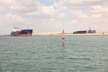
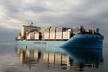
The current geopolitical situation in the Middle East, with the closure of the Strait of Hormuz and the suspension of several carriers in the Red Sea, is leading to critical consequences and uncertain situations also for Italian fruit and vegetable exports. The winds of war have forced a reorganisation of the sea routes, with direct effects on the efficiency of the supply chain. A further concern for Italian exporters is the solvency of customers. In times of war and logistical instability, there is a growing fear that supplies already planned or sent will not be paid for regularly by foreign trading partners.
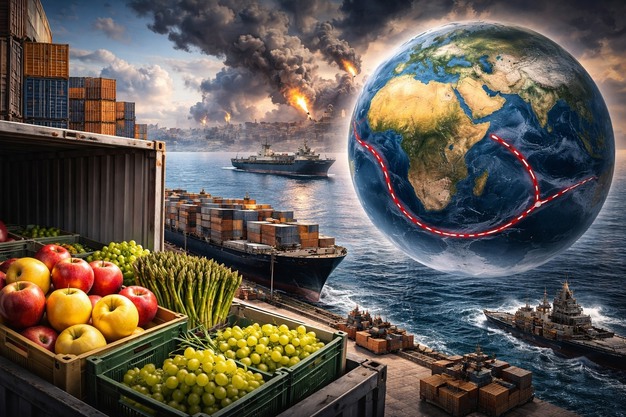 © ChatGPT/OpenAI
AI-generated image (ChatGPT/OpenAI)
Michele Ponso, president of the Confagricoltura National Product/Fruit Federation, reports that "There are considerable problems for fruit, especially apples. There are ships loaded with products that cannot reach their destination. In addition, a lot of cancellations have already arrived for the coming weeks."
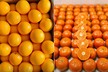
At 2.3 million tonnes, Italy is the second largest producer of apples in Europe after Poland, and the second largest exporting country in the world, right after China, with 945,000 tonnes sold or 12.2% of the world total. Saudi Arabia is the third largest market, with a value of around 70 million euros, after Germany and Spain. The entire Middle East is worth over 151 million. "It is therefore an important market, all the more so at a delicate time for the apple campaign, in which almost half of our harvested product still has to be sold."
There are also serious problems for the fresh-cut sector, which reaches those markets by air. Orders to Dubai (United Arab Emirates) have been cancelled as there are no planes available.
Domenico Sacchetto, President of OP Piemonte Asprofrut, told FreshPlaza that "The only alternative to the Red Sea is circumnavigating the African continent. This route drastically increases shipping time. In some cases, containers can take up to 90 days to reach their destination between stops and delays. Shipping companies are facing difficulties and slowness when it comes to re-routing (deciding on a change of route, ed), leaving many ships and containers in a stalemate. Longer transit times expose goods to a high risk of deterioration, compromising the quality of the final product on arrival."
What is worrying is not only the uncertainty about goods that have already left, but also the management of extra costs for companies. The entrepreneur is disillusioned when it comes to the unforeseen expenses for changing routes: "Getting reimbursed by insurance companies nowadays becomes difficult. Added to this are the serious fears of a new surge in the costs of packaging and electricity, which are essential for storing fruit."
Sacchetto highlights a deep concern about Italy's structural vulnerability. "The absence of nuclear energy makes our country dependent on imports and subject to fluctuations in gas prices. After the closure of relations with Russia, Italy diversified its sources by drawing heavily from Qatar. It is estimated that around 50% of recent energy supplies come from that area, making the Middle East crisis a threat not only to exports, but to the entire national energy system."
 © ChatGPT/OpenAI
AI-generated image (ChatGPT/OpenAI)
The Middle East is not a marginal destination for Italian fruit and vegetables. Dubai serves as a central hub for the distribution of produce throughout the region. Critical issues concern shipments to the United Arab Emirates, Qatar, India, and other countries in the region, which, in this seasonal period, represent an important outlet for Italian products.
The Middle East, and Dubai in particular, has long been a strategic market for Canino PGI green asparagus. The president of COPA, Sergio Marcoaldi, comments that "We do not know how the situation will evolve. Luckily, our customers have not suffered any damage, but we will have to wait and see what will happen in the coming days. We usually start with asparagus in March."
Gianni Raniolo, president of Consorzio di Tutela dell'Uva da Tavola di Mazzarrone IGP, reports that conversations with partners and friends in the Arab Emirates have revealed a sharp contrast between official communications and external perception. "It is impossible to say anything at the moment... they are trying to reassure us. We will see how the situation will evolve in the coming months." Despite the fact that the trading partners act as if everything is normal, Raniolo fears long-term repercussions such as the rising cost of raw materials like oil and fertilisers. The Sicilian grape campaign is expected to be favourable, with normal, quality production expected by the end of May/beginning of June.
Article by Rossella Gigli and Maria Luigia Brusco