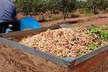
UK arable farmers seeking alternative high-value crops suited to a changing climate are being encouraged to consider hazelnut production in an agroforestry-style orchard system.
Suffolk farmer and Nuffield scholar Tom McVeigh says hazelnuts can provide a market-based income stream that does not rely on government support. He estimates gross margins of £10,000 per hectare. "Cereal prices aren't sustaining our businesses at the moment," says Tom. "We have a choice between waiting for government support and an uplift in grain markets or taking control of our own destinies."
Hazelnuts are described as a mechanised crop option with cereal-type specification and access to a global market. At least 70% of global demand is for nuts sized 11-13mm, making traditional UK cobnuts at 18-19mm unsuitable. "That's why American hazelnut varieties are required for new UK orchards. They have performed better, produce the right size and shape of nut, and can attract a premium."
Most hazelnuts consumed in the UK are imported from Turkey, with additional production in Spain, Italy, France, the U.S., and Chile. Turkish yields are reported at 0.8t per hectare and are largely hand-harvested. In other regions, production is mechanised.
Climate factors are affecting European production, including warmer temperatures, reduced chill hours, and pollination. France has reported yield losses of 20% due to the Eurasian stink bug. "Hazel trees pollinate over the winter, so late frosts can be an issue. That was a particular problem for Turkey last year." McVeigh stresses the importance of integrated pest management in orchard design.
Scale is required for processing infrastructure. A cleaning plant would need 400 hectares of orchards to justify investment, and 1,000 hectares for a cracking facility. Around 250 hectares have currently been pledged. "I've calculated that 20ha of hazelnuts is one man's work," says Tom.
Establishment costs are estimated at £10,000 per hectare, with annual maintenance around £3,500 per hectare. Payback is projected at eight to nine years. First harvest occurs in year five, with yields building to 3-5t per hectare. Current in-shell prices are £4,500 per ton, although calculations are based on £2,800-£3,500 per ton.
Production requires fertigation and up to 80kg of nitrogen per hectare. Harvest takes place in September after the nuts fall naturally, using mechanical sweeping and vacuum systems. Additional opportunities may include carbon payments, biodiversity net gain, and truffle production within orchards.
Source: Farmers Weekly