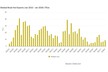
The United States pistachio industry concluded its largest crop on record, finishing just over 1.5 billion pounds. Although early estimates were higher, demand has absorbed volumes across key export destinations, including India, Brazil, South Korea, and Europe.
Rich Kreps, a board member of American Pistachio Growers and consultant with Ultra Gro, discussed crop performance, trade, and water management. He noted that global demand is supported by consumer interest in nutrient-dense foods and production practices in California, including soil health management and reduced pesticide and herbicide use compared to several row crops.
On tariffs, Kreps said demand for nutrient-dense crops such as pistachios, almonds, and walnuts remains steady despite trade barriers. He indicated that California continues to supply global markets where nutrition is a purchasing factor.
Domestic pistachio consumption in the United States appears relatively flat in volume terms. Kreps explained that a larger share of pistachios is now sold as kernels rather than in-shell, affecting traditional consumption metrics. Export demand continues to expand, supported by convenience formats and market access.
Water allocation in California was also addressed. Following above-average reservoir levels after multiple winters, some westside growers began the season with allocations as low as 10 per cent. Kreps said late or uncertain allocations affect crop planning even when water is later released. He also referenced carbon sequestration in cropped land compared to fallow ground and the financial impact on growers paying for unallocated water.
He encouraged increased engagement at local and national levels, particularly regarding water management in the Southwest and along the Colorado River watershed.
From an agronomic perspective, Kreps highlighted alternate bearing management as acreage expands, particularly with varieties such as Lost Hills and Golden Hills. He recommended a balanced fertility approach, focusing on more than 15 nutrients rather than concentrating primarily on nitrogen and potassium, with the objective of stabilising yields.
Kreps also supported adaptive management strategies using soil tests, tissue sampling, and water quality data in place of traditional practices.
Source: AgNet West