Sea-Intelligence has released issue 173 of its Global Liner Performance report, presenting schedule reliability data through December 2025. The report analyses performance across 34 trade lanes and more than 60 carriers. The following summary highlights selected findings.
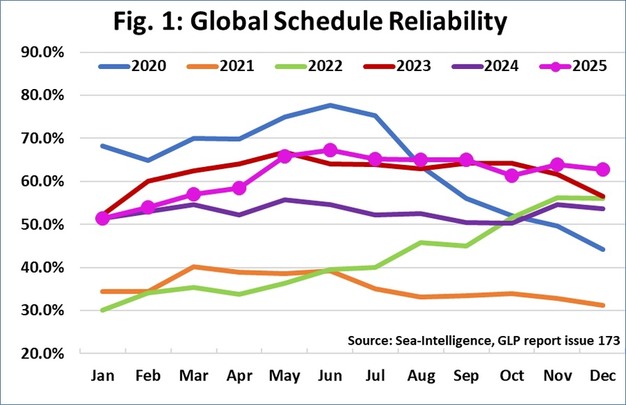
In December 2025, global schedule reliability declined by 1.2 percentage points month on month to 62.8 per cent, marking the second-lowest monthly level since May. Compared with December 2024, reliability improved by 9.0 percentage points. The average delay for vessels arriving late increased slightly month on month by 0.04 days to 5.04 days, the second-highest level recorded since April. On a year-on-year basis, average delay improved by 0.29 days.
 © Sea-Intelligence
Among the top 13 carriers, Maersk recorded the highest schedule reliability in December 2025 at 76.7 per cent, followed by Hapag-Lloyd at 75.2 per cent. MSC and HMM posted results in the 60 to 70 per cent range. Eight of the remaining nine carriers recorded schedule reliability between 50 and 60 per cent, while Wan Hai ranked lowest at 47.8 per cent. Four carriers showed a month-on-month improvement, while all 13 carriers recorded year-on-year gains.
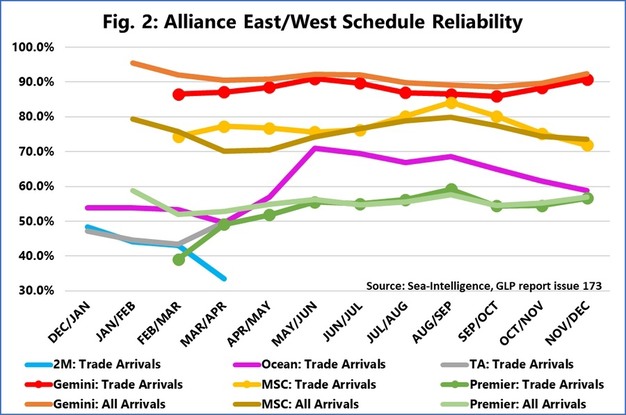
Looking at alliance performance in November and December 2025, Gemini Cooperation recorded a schedule reliability of 92.3 per cent across all arrivals and 90.8 per cent across trade arrivals. MSC recorded a reliability of 73.5 per cent for all arrivals and 71.9 per cent for trade arrivals. Premier Alliance posted 56.9 per cent for all arrivals and 56.6 per cent for trade arrivals. Among the previous alliance structures, where all arrivals and trade arrivals remain equivalent, Ocean Alliance recorded a score of 58.8 per cent.
 © Sea-Intelligence
Alliance performance has traditionally been measured based on arrivals at destination regions. However, due to the rollout of new alliance structures, Sea-Intelligence introduced an additional metric that includes all vessel arrivals, including origin calls on East–West trades. The report continues to present both measures, labelled "all arrivals" and "trade arrivals". As alliance structures complete their rollout, the two measures are expected to align more closely.
For more information:
Alan Murphy
Sea-Intelligence
Email: [email protected] / am@sea‑intelligence.com
www.sea-intelligence.com