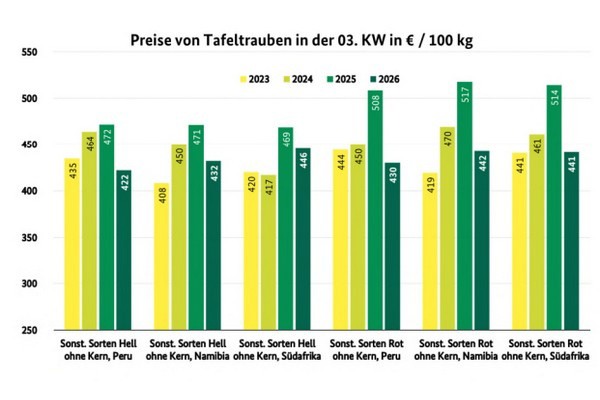
Imports from Namibia, Peru, and South Africa formed the basis of the supply. Deliveries from Namibia had apparently increased: According to the German BLE, various IFG varieties were selling at high prices. In Berlin, IFG 19, also known as Candy Hearts or strawberry grapes, cost up to EUR 9 (USD 10,57) per kg. In Frankfurt, Peruvian Autumn Crisp grapes sold for up to EUR 40 (USD 46,99) per 8.2 kg crate. Of course, there were also significantly cheaper offers, which were generally in good demand. For example, Black Seedless from Namibia appeared in Hamburg, selling for EUR 18 to EUR 20 (USD 21,14-23,49) per 4.5 kg package.
 © BLE
© BLE
Overall, there was demand, but it was not particularly strong. It could be satisfied without difficulty. Prices, therefore, often remained at the previous week's level. Although there were fluctuations, no major outliers were observed. Only in Hamburg was availability too high, which is why prices generally tended to fall.
Click here for the full market and price report.
Apples
Domestic loads dominated the market, followed by Italian and French deliveries. Supplies from the Netherlands and Poland supplemented the trade.
Pears
Due to limited storage capacity, traders had to revise their previous prices downwards in some cases.
Oranges
Spanish deliveries continued to dominate the orange market, with Navelina now increasingly flanked by Navel. Salustiana from the same origin gained a little in importance.
Small citrus fruits
The presence of Spanish mandarins apparently expanded, with Clemenvilla and Tango gaining immense influence. Orri came from Israel, which impressed with its quality and normally topped the ratings.
Lemons
Spanish Primofiori dominated and were available in a monopoly-like manner in some cases. In some cases, they were flanked by Turkish Meyer lemons.
Bananas
Demand was not particularly strong and could be met without difficulty.
Cauliflower
Italian deliveries dominated the market. As a result of increased Spanish imports, traders were often forced to lower their prices for Italian produce.
Lettuce
Belgian lettuce was impressive in terms of weight, while Italian and French lettuce had problems in this regard in some places. The turnover of multi-colored lettuce was relatively quiet.
Cucumbers
Even though the availability of Belgian and Greek offers expanded, the overall supply remained rather scarce. It was led by Spanish deliveries, whose presence, however, had generally declined.
Tomatoes
A wide range of products was available, with numerous countries participating. Demand was largely favorable. Although it could regularly be met, prices tended to rise slightly.
Bell peppers
Spanish shipments dominated, but their availability was sometimes limited due to poor growing conditions and pest infestation.
Source: BLE