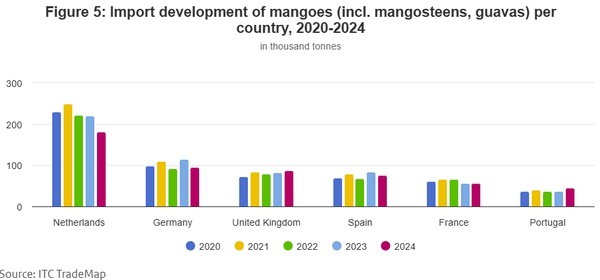
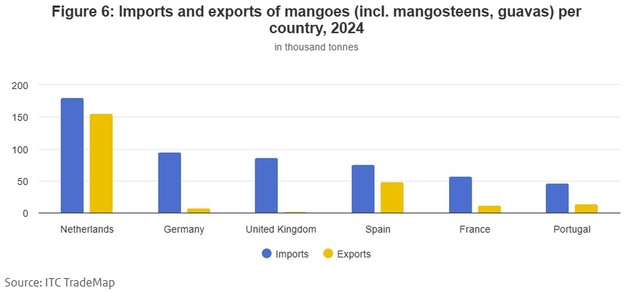
Mangoes are imported into Europe in increasing volumes, supported by year-round supply from multiple origins and growing demand for fruit with consistent eating quality. European consumers show a clear preference for low-fibre varieties, particularly Kent and Keitt, and demand is rising for mangoes sold as tree-ripe, ready-to-eat or fresh-cut. The main European import markets for fresh mangoes are the Netherlands, Spain, Germany, France, and Belgium.
The mango tree, Mangifera indica, is native to a broad area stretching from India to the Philippines. Mango is a fleshy stone fruit of the climacteric type, meaning it continues to ripen after harvest. More than a thousand mango varieties exist worldwide. Fresh and dried mangoes fall under HS code 08 04 50, which also includes mangosteen and guava, although mangoes account for the bulk of recorded trade volumes.
 © Government of the Netherlands
Fresh mangoes are marketed in several formats, including conventional whole fruit, ready-to-eat mangoes ripened at destination, tree-ripened fruit transported by air freight, and freshly cut mangoes sold in consumer packs.
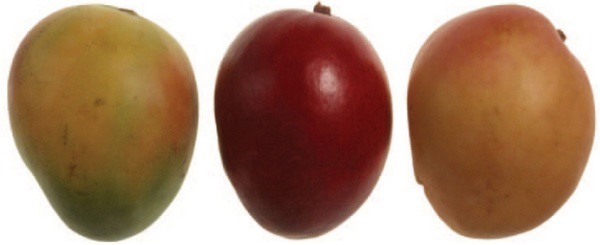
Kent remains the benchmark variety for the European market. It is produced in Latin America, mainly Peru, Brazil, and Mexico, as well as in West Africa, including Côte d'Ivoire, Senegal, Mali, Burkina Faso, and Guinea. Additional production takes place in Spain, Israel, and Egypt. Kent fruit is large and oval with a rounded base, typically weighing between 600 and 750 grams. When ripe, the skin is yellow-green with red or purple areas, while the flesh is yellow to orange-yellow, firm, juicy, and without fibre. Kent is the standard European market variety and is available year-round, depending on origin seasonality.
Keitt is also widely accepted in Europe and is often used to complement Kent during periods of lower availability. Production is concentrated in Brazil, the Dominican Republic, Puerto Rico, West Africa, Spain, and Israel. Keitt fruit are large to very large, oval in shape, and weigh from around 510 grams up to 2 kilograms. Skin colour at ripeness is yellow-green with pink areas. The flesh is lemon-yellow to yellow, firm, with some fibre close to the stone.
 © Government of the Netherlands
Palmer is mainly associated with Brazil and West Africa. The fruit is oblong with a rounded base, weighing between 510 and 850 grams. At maturity, the skin turns bright orange-yellow with dark cherry to purple or violet areas. The flesh is firm, orange-yellow to yellow, with few fibres and a sweet, fragrant profile. Palmer is available year-round and is Brazil's main export variety.
Osteen is primarily supplied by Spain, Morocco, and Brazil. It produces elongated, oblong fruit with a rounded base and sometimes a small beak. Fruit weight ranges from 500 to 760 grams. When ripe, the skin is yellow-orange with purple or lavender areas. Flesh is firm, juicy, low in fibre, lemon-yellow to intense yellow, and sweet. Osteen is well-regarded by European consumers and is Spain's main export variety.
 © Government of the Netherlands
Tommy Atkins remains important for supply continuity, particularly from Brazil and Spain. The fruit is large, oval to oblong, weighing between 450 and 700 grams. At ripeness, the skin remains green with intense to dark red colouring, often covering most of the surface. Flesh colour ranges from yellow to dark yellow or orange, with a more fibrous texture and milder sweetness. It is available year-round and is the third most exported Brazilian variety.
Israel supplies several niche varieties. Omer or Kasturi produces oblong fruit with intense red skin at ripeness, weighing 400 to 600 grams. Flesh is soft, yellow, and low in fibre. Shelly is round in shape, yellow to red when ripe, weighing 400 to 600 grams, with firm, orange, fibre-free flesh. Maya or Aya is a small to medium round mango with a small stone, weighing 300 to 400 grams, with intense yellow flesh, no fibre, and a short season that marks the start of the Israeli campaign.
 © Government of the Netherlands
Valencia Pride originates mainly from West Africa, particularly Mali and Burkina Faso. The fruit is medium to large, kidney-shaped with a rounded apex and broad beak, weighing 600 to 900 grams. Flesh is firm, intense yellow and almost fibre-free, with a sweet flavour, but the season is very short.
Other varieties are present in Europe in smaller volumes. These include Amélie, Zill, and Smith from West Africa, with Amélie gradually disappearing; Haden from Latin America; Ataulfo from Mexico and Brazil; Irwin from Spain and West Africa; Alphonso, Chausa, Totapuri, and Sindhri from India and Pakistan, mainly for ethnic markets; and Nam Doc Mai from Thailand.
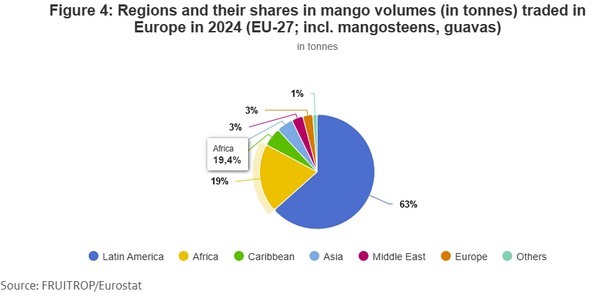
Europe is the second-largest importer of fresh mangoes worldwide. Demand is stable and continues to grow, supported by retailer promotions and a shift toward higher-quality eating experiences. Brazil supplies the European market all year, with Palmer, Keitt, Tommy Atkins, and Kent as its main export varieties. Osteen represents only a small share of Brazilian exports. Peru exports Kent mangoes exclusively and is known for consistent quality, although production has declined in recent seasons due to El Niño.
 © Government of the Netherlands
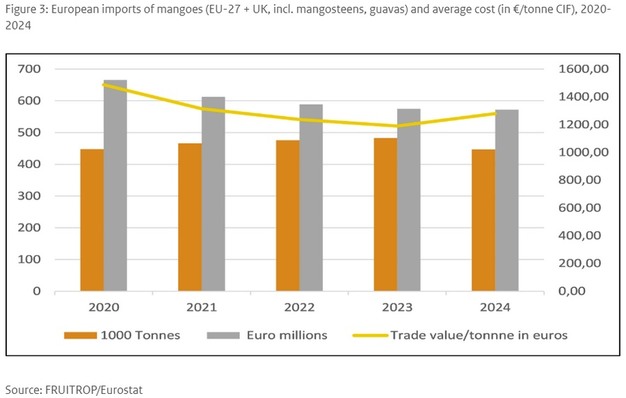
From 2020 to 2024, rising import volumes put downward pressure on average prices. Between 2023 and 2024, however, reduced Peruvian exports led to a drop in European import volumes of around 7 percent and contributed to higher average prices per tonne, which Brazilian volumes were unable to fully offset. West African exports typically face higher parasitic pressure, particularly toward the end of the season when the rainy period begins.
Despite a wide range of varieties, Kent remains the preferred mango in Europe due to its fibre-free flesh and reliable eating quality, making it the reference point for most exporters supplying the European market.
To view the full report, click here.
For more information:
Government of the Netherlands
Tel: +31 (0) 88 042 4300
www.cbi.eu