Vegetable production plays a central role in Michigan's agri-food system, despite ongoing pressure from rising input costs, labour availability, and regulatory requirements. Certain climatic conditions and soil types, particularly sandy and muck soils, make parts of the state suitable for vegetable production, while limiting the economic viability of crops such as corn, wheat, and soybeans on the same land.
 © MSU
© MSU
At the request of the Michigan Vegetable Council, staff from the MSU Product Center Food-Ag-Bio assessed the economic contribution of vegetable farming and processing in the state. The analysis focuses on economic contribution rather than alternative land-use scenarios. Impacts were estimated at both the farm and processing levels using IMPLAN economic modelling, including direct, indirect, and induced effects across the supply chain.
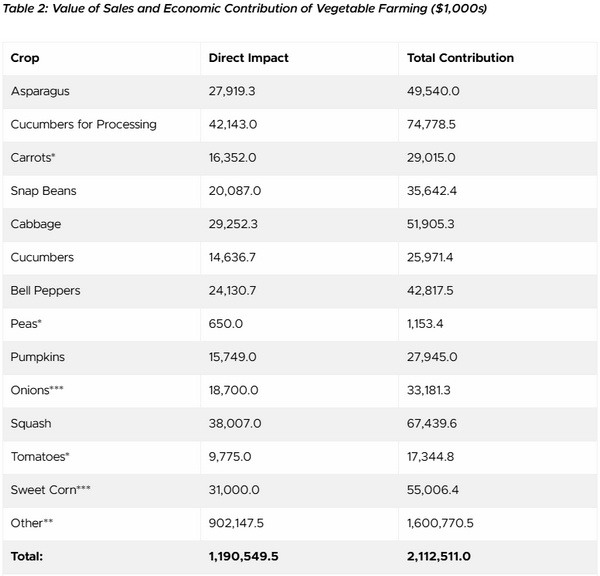
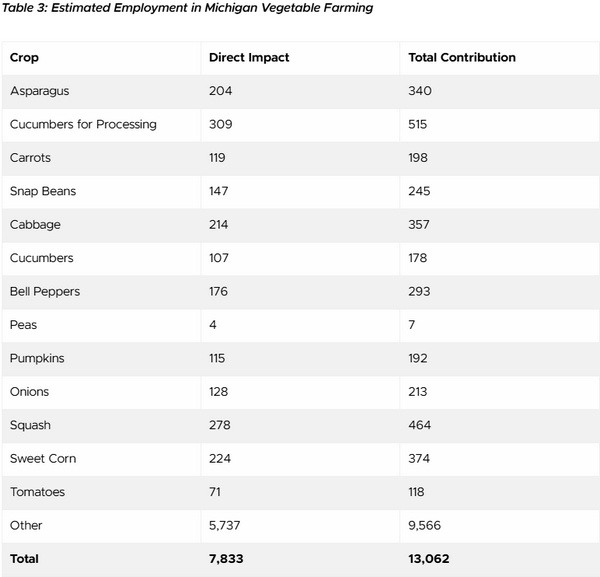
In 2022, Michigan had 3,213 vegetable farms cultivating 152,833 acres, according to the Census of Agriculture. Vegetable farming generated an estimated $1.19 billion in direct sales, with a total economic contribution of approximately $2.11 billion. These figures are considered indicative, as some production may be captured under broad reporting categories. Employment in vegetable farming is estimated at around 7,800 jobs, with a total employment contribution of approximately 13,000 positions once related activities are included. These employment figures are likely underestimated, as seasonal and migrant labour are not fully captured in the data.
 © MSU
© MSU
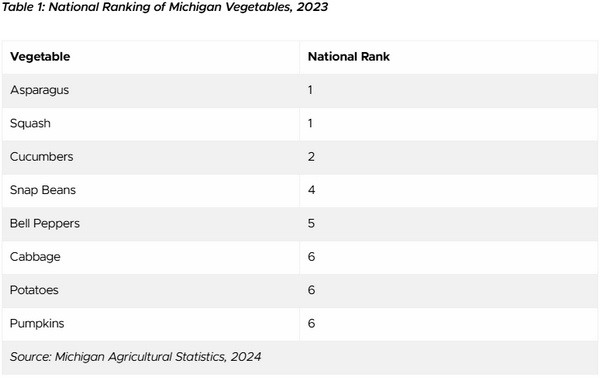
Michigan is a leading national producer of several vegetables. The state accounts for roughly half of US asparagus production and supplies a large share of cucumbers, squash, and dry beans. It is also a major producer of potatoes, particularly for processing. Average vegetable sales between 2022 and 2024 were stable at around $1.19 billion per year, suggesting consistent output despite production challenges.
Vegetable processing represents an even larger component of the sector. About 60 percent of Michigan's vegetable output is processed. The state hosts both frozen and canned vegetable facilities, including operations linked to major national processors. To isolate vegetable processing impacts, fruit processing activity was excluded from the analysis, meaning the resulting estimates may understate total sector activity.
 © MSU
© MSU
Vegetable processing contributes an estimated $1.92 billion in direct sales, with a total economic contribution of approximately $3.28 billion. Processing facilities employ about 4,400 people directly, while the overall employment contribution is estimated at roughly 13,400 jobs.
Combined, vegetable farming and processing contribute an estimated $5.39 billion to Michigan's economy and support approximately 26,400 jobs across production, processing, and related supply chain activities. These estimates highlight the scale of the sector, while also reflecting the limitations of available data.
To view the full report, click here.
For more information:
MSU
Tel: +1 517 355 1855
www.canr.msu.edu