It has been clear for ages that the Belgian, but also the Dutch, endive sector is struggling. Cost prices keep rising, the crop protection package is getting smaller and smaller and younger consumers seem to be dropping out. This season, prices are again so low that a cry for change has risen. "This situation is unsustainable," it sounds. Ignace Carron of Sanac also confirms this: "What we experienced in 2025 is really unprecedented."
 © Sanac
Sanac specialises in the trade of seeds, crop protection and all kinds of accessories. "We have been distributing Belgian endive seeds for many years, so we are in daily contact with people from all over the sector. As a result, we have a good overview of the whole chain, from cultivation to market," Ignace explains. "I have been working in this sector for 37 years now, but what I saw last year had not happened before. There are growers who have worked a full crop year at half the cost price. That takes on dramatic proportions for a lot of growers and is definitely not a sustainable situation. It is not only financially tough, but also emotionally taxing. The feeling of helplessness is significant."
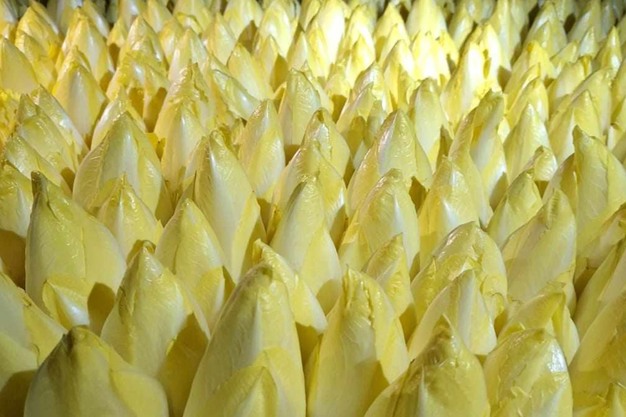
"The remarkable thing is that, crop-wise, we have had a fairly normal year. It was a bit wetter in 2024, so the roots grew nicely. The calibres were good and there was enough content in the roots, meaning they had the potential to produce good Belgian endive. It was not superb, but certainly more than enough. Still, we find that Belgian endive is not finding its way to consumers like it used to. The way the product is marketed and sold today raises questions and makes it difficult for many growers to recoup their investment."
France
In this regard, the experienced sector man argues that one has to ask what is going wrong here. "There are huge differences in the market if you compare our situation with that of our French colleagues. They manage to market their product more expensively than we do in Belgium and the Netherlands. You have to ask yourself what we are doing wrong here and how we can improve our system. Nobody could have predicted it would turn out like this. There are always challenges inherent in cultivation, because zero risk does not exist in agriculture. But that it would go in this direction, no one could have foreseen. It shows how dependent the sector is on market mechanisms, weather conditions and consumer behaviour, for example."
 © Sanac
In Belgium, several farms have invested and renewed in recent years. "However, innovating in agriculture often also means increasing scale to get out of costs. As a result, capacity has increased. In agriculture, of course, it has always been the case that supply and demand have to be in balance. As soon as there is too much supply, the price disappears. Today, there seems to be a structural oversupply. In fact, there is never a shortage of Belgian endive anymore, and this causes problems in sales. Growers are therefore under pressure and have to produce large quantities, while market prices often do not allow this."
So what can actually be learned from the French? "In France, they have learned over the years to better match supply to demand. They are organised differently there, in professional organisations and smaller cooperatives. Those cooperatives negotiate with the trade and also direct production. They have learned to sense the market: how much does the market need? In this way, they avoid overproduction and can achieve better prices."
"In addition, French pride in their own products plays a role. French traders buy from their own growers first. Only after that they look at what, if any, is available from outside. As a result, they do not sell below cost price but produce fewer kilos. This not only has financial advantages, but also protects the sustainability of the sector," he points out.
Consumer needs to catch on
He further argues that market forces and supply are very important things to look at, but the end consumer also plays a big role. "Consumers are also catching on. If you look at the consumption figures over the years, you will see that we are losing consumers every day. Regardless of the sector, without a consumer you have a problem. Unfortunately, I don't have a crystal ball to say how to solve that, but it is urgent that something is done."
 © Sanac
"We have to ask why consumers are dropping out. On the one hand, eating habits have changed. On the other hand, you are faced with the contradiction that when prices are low, growers try to produce more, but then the question arises whether the quality is still sufficient to convince consumers."
"In France, you see that 25 to 30 per cent of the market has switched to mini Belgian endive, 'Jeunes Pousses'. This is sold by the piece rather than by the kilo, for example in packs of five within a fixed weight range. That makes it possible to produce younger and fresher Belgian endive, which better suits consumer preference."
Concerns
Ignace therefore indicates that this situation is unsustainable, but remains hopeful. "A boom never lasts, but fortunately neither does a crisis. There will be improvement sooner or later, but the question is how heavy the losses have to be before that happens. In other years, the climate sometimes caused everything to recover by itself. 2025 actually had all the climatic conditions to produce less Belgian endive. It was hot and dry. Nevertheless, just enough rain fell at the right time each time. The sowing went well, the plants looked good and the roots developed deeply. As a result, there is now a lot of Belgian endive available again."
"That also causes concerns towards 2026. If we had had a shortage of roots and there was still space in the cold stores, it would have ensured a better spread of production, less supply and therefore more normal prices. Today's overproduction makes it difficult to maintain healthy pricing."
No clear solution
A vicious circle, is how Ignace describes it. "Maximising production, while wondering whether in doing so you are not ignoring what consumers actually want. The fact remains that there are very big challenges in the Belgian endive sector today. What I am outlining is only part of the whole. It is a complex story with many facets, and everyone has their own view on it. What is clear is that we are now 12 months on and there is still no clear solution in sight. It is really important that we as an industry start thinking about this very carefully."
For more information:
Ignace Carron 
Sanac
[email protected]
www.sanac.be