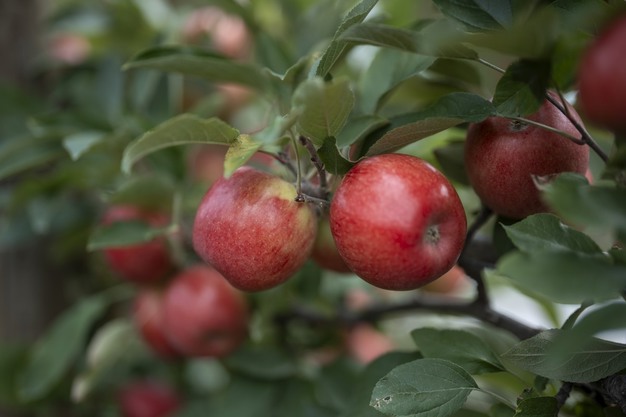
This spring marks 40 years since the development of two New Zealand apple cultivars, Scifresh and Scilate, now marketed internationally as JAZZ and ENVY. The varieties were created in 1985 by scientists at the Bioeconomy Science Institute, which at the time formed part of the Department of Scientific and Industrial Research. They were later commercialised under exclusive global licence by T&G Global, then operating as ENZA.
Apple breeder Dr Richard Volz from the Bioeconomy Science Institute said the two cultivars played an important role in the evolution of New Zealand's apple sector, particularly as early examples of licensed varieties that focused on flavour, texture, and storage performance at a time when global supply was becoming more uniform.
 © T&G Global
Dr Volz said that in the mid-1980s, traditional varieties continued to perform well as export crops, but the industry recognised increasing competition from southern hemisphere producers growing similar apples. He said that with higher production and shipping costs, New Zealand needed to develop new cultivars that could offer an advantage in international markets. This led to breeding work aimed at creating apples with improved eating quality and a clearly managed route to market.
More than 20 years of development followed. The breeding programme produced over 8,000 seeds from a cross between Royal Gala and Braeburn, of which around 7,000 seedlings were planted. From these, 211 trees were selected for an advanced evaluation orchard, where Scilate was eventually chosen. The resulting variety is described as having red colouring, high juice levels, and an aromatic profile linked to balanced acidity.
Scifresh and Scilate were launched commercially in 2004 and 2008, respectively, and developed into global brands grown across both hemispheres. Today, they are supplied to more than 50 markets.
T&G's Chief Operating Officer Apples, Shane Kingston, said the long-term performance of the varieties reflects the systems built around them, including intellectual property stewardship, orchard production, post-harvest processes, and market development. He said the apples have established positions in several markets, with ENVY widely sold in China, Taiwan, Hong Kong, Vietnam, Thailand, and the United States, and JAZZ holding strong import positions in Japan, the United Kingdom, and Australia.
Both varieties are now grown under licence in multiple countries. JAZZ is produced in more than 11 countries and ENVY in more than 13, supported by quality standards intended to maintain consistency across the global network.
 For more information:
Michaela Nel
T&G Global
Tel: +64 21 404 857
Email: [email protected]
www.tandg.global
 © Bioeconomy Science InstituteLaura Ward
Bioeconomy Science Institute
Tel: +64 (0) 21 572 813
Email: [email protected]
www.bioeconomyscience.co.nz