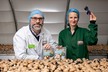
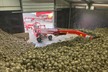
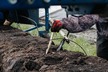
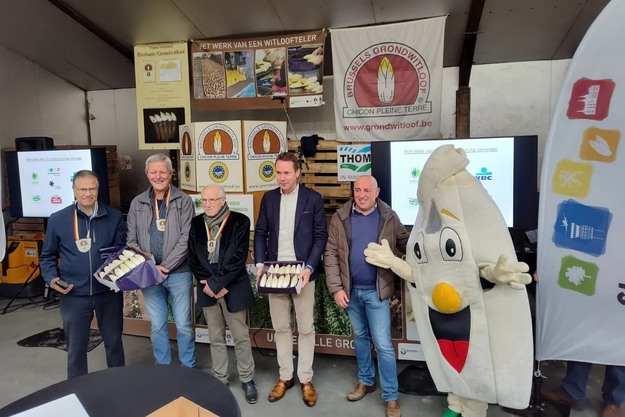
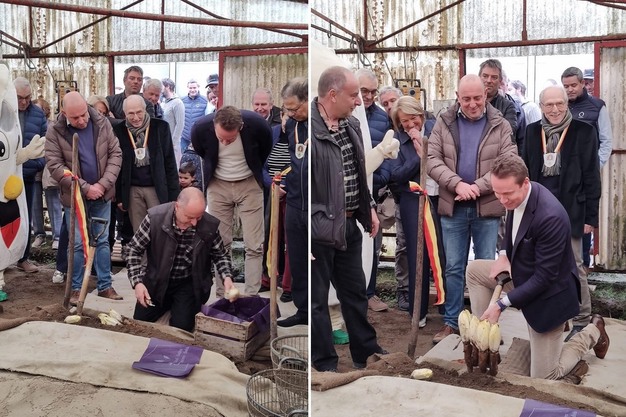
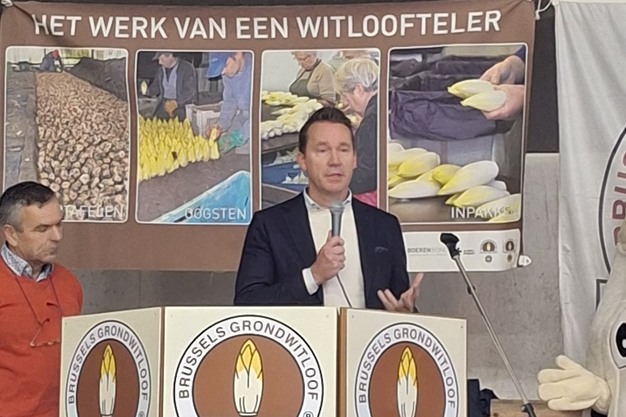
On Sunday, 19 October, the soil-grown Belgian endive season was officially opened in Steenokkerzeel. Among those present were Flemish Agriculture Minister Jo Brouns and Flemish Brabant deputy Tom Dehaene, who attended the launch at the De Winter - Marine soil-grown Belgian endive farm, a flagship of this quintessential Flemish regional product. "A great success," said Willy Vankelst of vzw Brussels Grondwitloof, but he also issued a warning: "As a sector, we will have to take action, otherwise the craft will have completely disappeared in a few years."
 © vzw Brussels Grondwitloof
At the Steenokkerzeel farm, which Rita Marine founded with her husband Patrick De Winter in 1981, the morning of Sunday, 19 October, was dedicated to the season's official kick-off. In the afternoon, the farm opened its doors to the public. Rita, who now runs the business alone following her husband's passing in 2021, guided visitors through the highs and lows of soil-grown Belgian endive cultivation. Willy said, "We saw extremely high interest, and the turnout in the afternoon, when the public joined in, was particularly good. The fortunate weather certainly helped boost attendance. Personally, I thought the official opening was one of the best in recent years."
Late season
He is moderately satisfied with the new season but notes that the trade must adapt to a changing reality. "The season started later than usual this year because of the difficult climate. Normally, we begin at the end of September, but it was quite dry, so root growth started slowly. As a result, harvesting began later, and processing was also delayed. Some growers are still behind schedule and have not started yet. This is inconvenient because retailers want the product on their shelves from the end of September to build up stock. Unfortunately, due to the climate and later start, we cannot always meet that demand."
"Weather dependency remains a challenge," Willy explained. "Retailers prefer a sales period from early September to late January or February. Then, they have shelf space available, but our season is shifting due to climate change. We start later but also continue longer, sometimes until the end of April. By then, consumer demand for endives is much lower. It is therefore important to raise awareness among both trade and consumers about this later availability. As an association, we are promoting this actively, including through discussions with retailers to extend the sales period."
 © vzw Brussels Grondwitloof
However, he also believes the trade can do more. "I think more attention should be paid to the quality of endive. As the product is quite expensive, consumers expect good quality. Unfortunately, this is not always the case, as the trade mainly focuses on price and volume and assumes mediocre quality will sell easily at a high price. This is worrying because if quality disappoints, we lose consumers. We therefore want to emphasise quality standards in the trade and raise awareness about them."
Creating awareness
Consumer engagement is equally important. "For example, we are already running campaigns to encourage consumers to keep buying endives even after January. The province of Flemish Brabant has also introduced endive boxes for individuals." To involve children in agriculture and healthy eating from a young age, the Witloofbox is being distributed to schools and after-school care centres in Flemish Brabant. The box offers a simple and playful way to learn about growing endive, a traditional Flemish product, the province says.
The box contains a cultivation kit with endive roots, a manual, and educational materials such as the comic strip Wimmeke Witloof. It has been specially developed for nursery and primary schools as well as childcare centres in Flemish Brabant. With the Witloofbox, the province aims not only to teach children where their food comes from but also to spark their curiosity about agriculture and the seasons. "It all contributes to our shared goal of keeping endives in the spotlight," he said.
 © vzw Brussels Grondwitloof
Will there still be endives in 10 years?
Such initiatives are essential, he argues. Speaking to Belgian broadcaster VRT, grower Johan Lauwers already predicted there would be no more endives in 10 years. "These are concerns I share," Willy confirmed. "The number of endive growers has dropped significantly since I started at VZW Brussels Grondwitloof about 30 years ago, from around 400 growers to just about 100 today. This is mainly because many older growers are retiring without successors. Moreover, within five years, half of the current growers will be between 55 and 65 years old, meaning even more will retire."
"Young growers are coming in, but they cannot yet fully offset the decline. Still, we as a non-profit organisation are actively working with growers to find solutions. It is a major challenge, especially since the trade expects a stable supply. Certain cultivation techniques could allow for acreage expansion. An average endive grower cultivates between 3 and 8 hectares, which is insufficient to meet demand. Some form of automation will be necessary, and a few growers are already working on this to manage larger areas. Ultimately, this could help compensate for the loss of retiring growers. It remains to be seen, but these are steps in the right direction."
For more information:
Willy Vankelst
Asbl Brussels Grondwitloof
Walenweg 41
1930 Nossegem, Belgium
[email protected]
www.grondwitloof.be