Unfavorable weather conditions led to another below-average fruit harvest in 2024. Late frosts in the main production area of Styria caused significant losses in pome fruit. Regional flooding in the summer and fall also led to a decline in yields. In commercial fruit growing, the drop in apple production resulted in the second-lowest total production in recent years (23% below the previous year's figure). This is according to the AMA annual report.
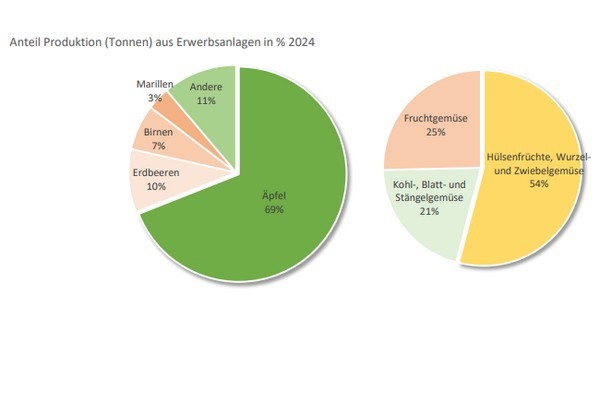
Apples, which accounted for 90% of the pome fruit harvest, yielded a production volume of around 104,000 tons in 2024 (-33% compared to 2023). Pears, which were severely affected by frost in the previous year, achieved a significantly higher yield than in the previous year (+58%) at 10,300 tons.
At 5,200 tons, 36% more apricots were harvested than in the previous year. Lower Austria, the main producing province, accounted for 60% of the production volume. Cherry and sour cherry production was up 14% on the previous year, with a harvest volume of 2,500 tons. Of this, 94% were cherries (2,350 tons). The strawberry yield in 2024 was 14,300 tons, just below the previous year's level (-2%). The fruit came mainly from Lower Austrian, Upper Austrian, and Styrian cultivation.
 © AMA
© AMA
Slight increase in vegetable harvest
In 2024, Austrian vegetable production amounted to around 668,000 tons on an unchanged area, 3% more than in the previous year. The exceptionally warm spring ensured an early start to the season, which benefited most types of fruit and vegetables. Despite a reduction in acreage, 58,100 tons of tomatoes were produced (+2% compared to 2023). The cucumber harvest was estimated at 43,000 tons, which is almost the same as the previous year (-1%). Three-quarters (76%) of the total cucumber production came from protected cultivation.
In 2024, pepper production increased by 4% to a total of 13,700 tons. Of this, 97% came from cultivation under glass and foil. Weather-related losses, such as heat and drought damage, but also increased fungal and pest pressure and even flood damage, caused problems for outdoor crops in 2024. Lettuce lost 5% of its acreage compared to 2023, resulting in a reduced production volume of 47,400 tons (-11% compared to 2023). Chinese cabbage achieved a production of 11,700 tons (-1% compared to the previous year) on a constant acreage. Asparagus benefited from the warm spring and achieved a harvest of 2,700 tons (+17% compared to 2023).
Onions, which accounted for over a quarter of total vegetable production, recorded a harvest of around 175,100 tons (+10% compared to 2023) on an unchanged area. Heavy rainfall and humidity during the harvest period resulted in mixed quality, so that the net yield was ultimately significantly lower. The area under carrots increased slightly in 2024 (+1%). At 120,600 tons, the same level as the previous year was achieved.
Domestic self-sufficiency highly seasonal
Austria is traditionally a net importer of fruit and vegetables. The degree of domestic self-sufficiency fluctuates considerably depending on the season. Due to changing consumer habits towards small berries, tropical fruits, and exotic fruits, the demand for imported fruits and vegetables has risen significantly in recent years. Considering climatic challenges in countries of origin such as Spain and Italy, strengthening self-sufficiency in fruit and vegetables will become increasingly important in the future.
According to the latest supply balances from Statistik Austria, Austrian agriculture produced 316,837 tons of fruit, 721,482 tons of vegetables, and 594,037 tons of potatoes in 2023/24. Due to the below-average pome fruit harvest, the degree of self-sufficiency reached only 33% for fruit, 55% for vegetables, and 78% for potatoes.
Source: AMA