Around 1 million tons of passion fruit are grown worldwide, with more than 80% produced in South America. Brazil is by far the largest producer, followed by Colombia, Peru, and Ecuador. Among these four countries, Peru is the leading exporter, mainly shipping pulp and concentrate. Suriname is also making progress in growing and processing passion fruit, known locally as markoesa. Daniel Durga, director of Agro Surbra, began cultivating the crop as a hobby ten years ago. Today, he is regarded as one of the pioneers in Suriname's passion fruit industry.
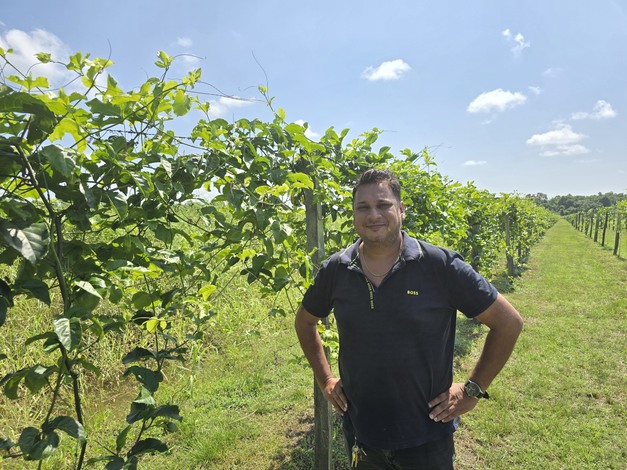 © Pieter Boekhout | FreshPlaza.comDaniel in the young passion fruit plantation
"Almost every year I adjust the cultivation model," Daniel says. "Each year, I learn and make improvements. For example, passion fruit is very sensitive to excess water. For the next planting, I will raise the beds by half a meter so the roots don't rot during the rainy season."
Daniel invests heavily in research, particularly in disease and pest control. Since local scientific research is virtually non-existent in Suriname, he takes matters into his own hands. Every year, he replants crops to test what works and what doesn't. The seeds he uses come from certified Brazilian growers in subtropical regions. "We select for adaptability. The crops have to be able to survive here," he explains.
 © Pieter Boekhout | FreshPlaza.com
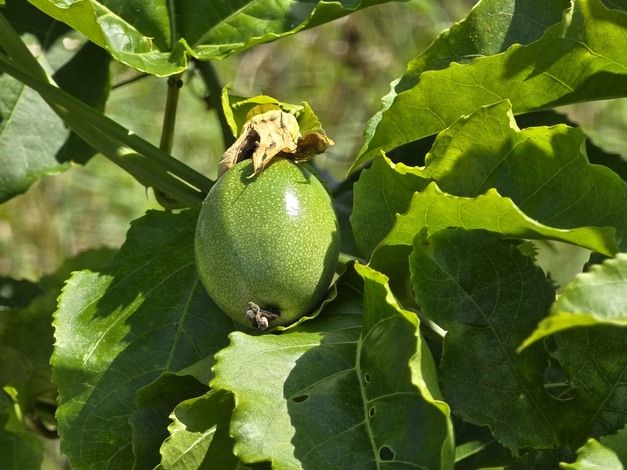
Although Suriname has a native yellow markoesa, the Brazilian varieties, also yellow in color, yield more juice. This fruit is yet to discolour.
Although Suriname has a native yellow markoesa, the Brazilian varieties, also yellow, deliver more juice. "At least 30% juice yield is required; otherwise, it becomes economically unviable."
Purple passion fruit
Purple passion fruit is also in demand. "Especially in the catering industry," says Daniel. "They use it as a garnish, but the peel must be free of residue. And that's the problem: this variety is extremely susceptible to disease." That's why he is now moving to grow purple passion fruit in a greenhouse. "With a plastic roof and mesh on the sides. The greenhouse will be one hundred meters long and eight meters wide. This way, I hope to reduce the use of plant protection products drastically."
 © Pieter Boekhout | FreshPlaza.com
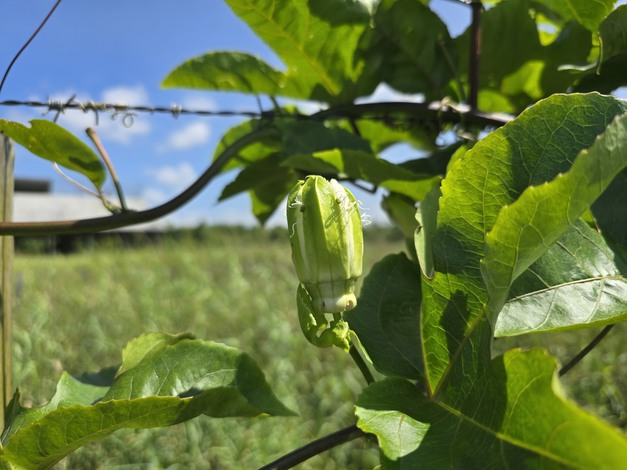
Growing passion fruit is labor-intensive, especially for pollination. Here is a picture of a passion fruit flower.
Juice factories
Although Suriname has three major juice factories, they rarely buy local fruit. Instead, they import concentrates, mainly from the Netherlands. "They want volume, continuity, and uniformity," Daniel explains. "Small-scale growers can't guarantee that, so the factories prefer certainty." Market dynamics also play a role. "When the price is good, growers sell to the fresh market. When prices drop, only then do they approach the juice factories. But that's not how it works. So the factories say: Then we'll import."
Daniel does not target domestic juice factories. "They pay too little, in my opinion. My goal is exports." And even though he has enough volume to produce juice himself, he deliberately chooses not to. "There's enough competition in the juice market. I won't enter that battle."
Instead, he looks abroad—to juice producers in the Caribbean or even Belgium. "There, passion fruit is increasingly used as a flavoring," he says. A customer in the Netherlands is also interested. "He makes syrup for shaved ice."
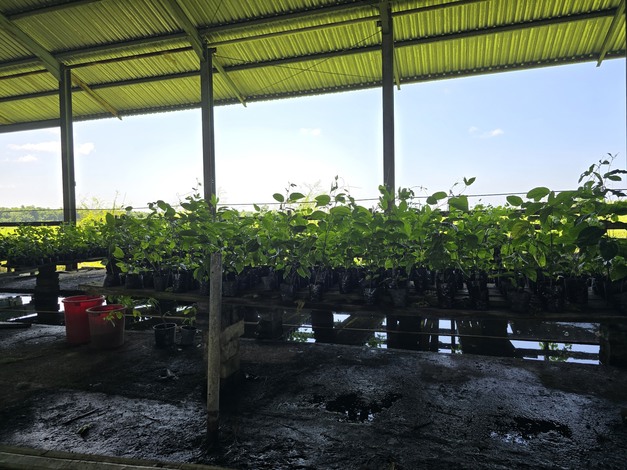 © Pieter Boekhout | FreshPlaza.comOwn propagation plant material.
Manual pollination
Growing passion fruit is labor-intensive, particularly during pollination. "If you let bumblebees do the work, only about 40% of the flowers are pollinated. Manually, you can raise that to 80%." And that requires skill. "You have to do it with a brush between 2 and 5 p.m. In the morning, the flowers open, but they need full sun before the pollen is released."
The infrastructure for a passion fruit plantation is not cheap, says Daniel, who is experimenting with alternative planting methods, such as planting in rows—similar to vineyards in Europe—to save on materials and costs. "For one hectare, you need about 900 poles. Ten years ago, these cost a tenth of what they cost now. Just the basic setup costs about €10,000 per hectare."
Because passion fruit cultivation requires significant investment, there is movement at the government level as well. During the previous administration, a project was launched to support 200 growers, each with one hectare of land. The subsidies are provided in kind—poles, wire, and planting material. The condition is that the growers join a cooperative responsible for marketing and processing.
Daniel also believes in the model of small family farms with one or two hectares. "They're less dependent on staff, and finding workers is difficult here," he says. The pioneer even tries to inspire others. "I share my knowledge and business model freely. That's my contribution to the sector."
For more information:
Daniel Durga
Agro Surbra NV
Saramaccaweg to Coppename km 82.5
Suriname
Tel: +597 8932364
[email protected]
Published in this special:
1. Suriname offers many opportunities: plenty of water, land, sun
2. Photo report at the two only supermarket chains in Paramaribo
"Supply of acerola cannot keep up with European demand" 3.
4. "There will always be demand for Surinamese fruit and vegetables from the Netherlands"
5. Imports in tropical Suriname are replaced by local lettuce, peppers, and tomatoes from the greenhouse
6. Export of Surinamese bananas to Europe coming back into focus
7. Dutch fruit importer starts large avocado plantation in Suriname
8. From greenhouse dream to knowledge shortage: Suriname growers seek a way out of uncertainty
Want to know more about cultivation and trade in Suriname, contact Anilkumar Padarath of the Chamber of Commerce and Industry:[email protected]