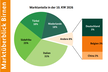
The global blueberry industry recorded a stage of recovery and consolidation in 2024, with volumes reaching 2.15 million metric tons (MT), up 21% from 2023, according to the International Blueberry Organization (IBO, 2025). The fresh fruit segment accounted for 1.67 million MT, a 20% increase, with average yields of 9,190 kg/ha supported by technological and genetic advances in the main producing areas.
Regional production dynamics
The Americas contributed 46% of global production at 996,000 MT. South America reached 503,000 MT following recovery from El Niño effects, while the US and Canada produced 424,000 MT. Mexico and Central America added nearly 70,000 MT, strengthening their role as off-season suppliers.
Asia-Pacific registered 752,000 MT (35% of the total), led by China with 712,000 MT. The EMEA region (Europe, the Middle East, and Africa) produced 402,000 MT, up 18.7%. Growth was strongest in North Africa and Southern Europe, with Morocco, Egypt, and Portugal consolidating as supply hubs for the European market.
Processed segment
Processed blueberries reached 477,000 MT in 2024, absorbing surpluses from the fresh market. Industrial use focused on IQF, berry blends, and derivatives for the food sector. Mechanization has maintained profitability, though investment in processing infrastructure remains concentrated in the Pacific Northwest and Chile.
Processed organic blueberries obtained a 33% price premium over conventional fruit. In Chile, nearly 20% of processed exports were organic.
Data accuracy and sustainability issues
The IBO report highlighted concerns over plantation data reliability. The official estimate of 279,000 hectares may be understated by as much as 7,000 hectares due to unregistered or informal plantings, particularly in China, India, North Africa, and the Middle East. This underreporting complicates forecasting and market planning.
Sector challenges include water stress, labor shortages, and the requirement for genetic innovation to sustain yields under extreme climate conditions. Diversification into processed products and new industrial uses, such as protein bars, yogurts, and ready-to-eat items, provides additional market outlets.
Outlook
From 2025 to 2030, the sector is expected to show structurally higher production levels, supported by agricultural technology, geographic expansion, and integration across the value chain. Consumption, which currently averages just above 1 kg per person worldwide, is projected to grow, with Asia and the Middle East offering the strongest potential. The IBO notes that water management, genetic development, and post-harvest quality will be key factors in maintaining competitiveness.
Source: Blueberries Consulting