Fruit growers on Lake Constance, Germany, expect this year's apple harvest to yield around 227,000 tons, which is slightly down on last year but still around 9,000 tons more than in 2023. The quality is very good, with a balanced sugar-acid ratio and good firmness.
On Thursday, August 28, 2025, fruit growers will celebrate the official opening of this year's apple season at the Steffelin family's fruit farm in Ittendorf with a positive outlook for the future. The apple harvest on Lake Constance has begun in recent days, and fresh, crisp apples are once again being harvested.
"As Germany's second-largest fruit-growing region, the area will continue to play a prominent role in domestic production in 2025. While other growing regions suffered significant losses last year due to weather conditions, particularly late frosts, the Lake Constance area enjoyed an above-average harvest in 2024, accounting for around 45 percent of Germany's total apple production," said Erich Röhrenbach, who, together with Thomas Heilig, is chairman of Obstregion Bodensee e.V., at the opening of the 2025 Lake Constance apple season.
In his review of the season, Röhrenbach reports a relatively mild winter with little precipitation and an early, but not too early, start to spring. "We were largely spared from frost nights, which were significant in other parts of Europe, especially in Poland. Spring and summer were relatively dry, in stark contrast to last year. We always had just enough rainfall, but we saw that we were at the limit of what our apples could withstand. Fortunately, at the end of July and beginning of August, just in time, there was enough rain for our apples and pears to grow and the fruit-growing families to breathe a sigh of relief."
 © Obst vom Bodensee GmbH
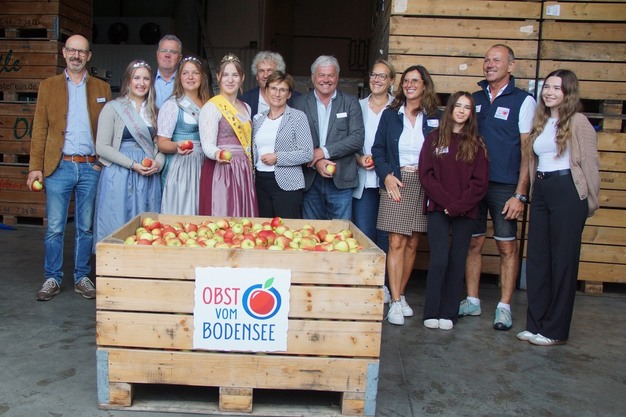
Group photo of the speakers, Lake Constance apple royalty, and the Steffelin family.
Minimum wage increase and crop protection
In addition to his optimistic view of the market, Erich Röhrenbach also reports on the difficult conditions for German fruit growing. One of the most pressing problems continues to be the planned increase in the minimum wage, which will certainly place a burden on the entire German middle class, but especially on labor-intensive sectors such as special crop cultivation in fruit growing.
In this context, he once again emphasized the need for good protection systems, such as hail nets, plant protection, and irrigation options, as well as multi-risk insurance and sustainable projects such as FAIRDI to preserve family farms, secure the supply of local fruit, and at the same time, maintain the beautiful cultural landscape.
FAIRDI marketing concept bears fruit
He has particularly high hopes for the continuation of the new FAIRDI cultivation and marketing concept as an opportunity to reduce the use of pesticides, increase biodiversity, and increase profit sharing for producers, in line with the motto: "Fair to the environment, fair to society, and fair to producers."
Even though the first Mammut apples were marketed in accordance with the concept four years after the project began, the initiators remain dependent on financial support from the ministry.
The chairman calls on the younger generation, in particular, to buy local fruit instead of avocados and exotic fruits from overseas. In addition to the short transport distances, which have a positive effect on the carbon footprint, this also contributes to promoting biodiversity in the region through the fruit-growing families.
Anja Renz, the new managing director of Obstregion Bodensee e.V., then introduced herself. She already discovered her passion for professional work for fruit-growing families as interim managing director in 2019 during the "Save the Bees" referendum, and now, following the move of her former successor (and now also predecessor), Andreas Ganal, to MaBo, she has seized the opportunity to return. As a trained lawyer and employee in her husband's small part-time fruit-growing business, her commitment to fruit farmers is perfectly suited to her skills. For her, it feels more like a calling than a job.
Sustainable development of local fruit growing
State Secretary Sabine Kurtz from the Ministry of Food, Rural Affairs, and Consumer Protection speaks to the guests as the guest of honor. She conveys greetings from Agriculture Minister Hauk and emphasizes the importance of Lake Constance fruit growing for the self-sufficiency of healthy fruit, as every fourth apple harvested in Germany now comes from the approximately 6,500 hectares of cultivation area in the Lake Constance region. "The German Lake Constance region is one of the world's best climatic areas for growing aromatic fruit, and a fruit farm as diverse as that of the Steffelin family provides a wonderful backdrop for the opening of the apple season."
Kurtz also explains the importance of the "FAIRDI" project, which is financially supported by the ministry. "This initiative, supported by practitioners from the fields of fruit growing, science, and politics, plays an important role in the sustainable development of local fruit growing. In Baden-Württemberg, we focus on regionality, especially in connection with our quality programs. The program to promote the fruit and vegetable sector provides the fruit industry with a special support instrument that gives producer organizations a comparatively large amount of leeway."
Kurtz emphasizes the important contributions of fruit growers to society, not only in terms of food security, but "also from an economic perspective, fruit growers are one of the cornerstones of the Lake Constance region. Through their work, they maintain and preserve this special cultural landscape, where people love to spend their vacations. I, too, enjoy coming back to Lake Constance with my family time and again."
In recent years, energy production has been added to the mix, as well as the important contribution to education, which is often overlooked. "The Lake Constance Fruit Growing Competence Center is a hotspot for science, research, and wide-ranging education in the field of fruit growing. The state government will make every effort to maintain the political framework conditions that enable fruit growing to continue to develop," said State Secretary Kurtz.
Dr. Ulrich Mayr, deputy managing director of the aforementioned KOB, reports in his keynote speech on the opportunities and possibilities for future-oriented fruit growing based on the breeding of new, scab-resistant, and robust apple varieties. Cultivating these varieties is becoming increasingly attractive for fruit growers, as they now meet the high-quality requirements for dessert apples, thereby enabling a significant reduction in the use of pesticides. This not only lowers the costs of cultivation but also meets consumer demand.
Harvest forecast and current situation
In the report on this year's harvest forecast and market outlook, Jürgen Nüssle, managing director of the Württembergische Obstgenossenschaft Raiffeisen e.G. (Württemberg Fruit Cooperative), reports: "At Lake Constance, we will harvest approximately 227,000 tons, which is 10% less than the 258,000 tons harvested last year, but more than the 218,000 tons harvested in 2023. The estimated EU apple production for this harvest is 10.455 million tons, almost the same as last year (final evaluation: 10.468 million tons). This means a 0.13% smaller harvest than last year, but on average over the last three years, it is actually 7.53% less. This is the smallest harvest in the last five years."
The largest producing countries are Poland with 3.3 million tons, an increase of 110,000 tons over the previous year; Italy with 2.2 million tons, a decrease of 81,000 tons; France with 1.4 million tons, an increase of 52,000 tons over the previous year; and Germany with 1.0 million tons, which means that 14.68% more domestic regional apples are available for Germany. "These countries continue to produce approximately 75% of all European apples. In general, however, it should also be noted that the area under cultivation has decreased by 10% to 475,000 hectares over the last 10 years. As in the previous year, apples from the 2024 harvest have been sold throughout Europe, with only small quantities of produce from the southern hemisphere available."
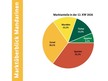
However, the increase of almost 15% in Germany corresponds to an increase of only 4% on a 3-year average. This is mainly due to crop failures in eastern Germany last year. Broken down by region, this amounts to 319,000 tons for the Lower Elbe, 227,000 tons for Lake Constance, 64,000 tons for Saxony-Anhalt, and 78,000 tons for North Rhine-Westphalia. Lake Constance and the Lower Elbe region alone account for 60% of total production in Germany.
Germany's main varieties are Elstar, the Jonagold group, Braeburn, and Gala. These varieties alone accounted for an estimated 499,000 tons, which is almost 50% of the German harvest. Two years ago, the market share of these varieties was still 70%. Club varieties achieved the greatest growth during this period. With an estimated 202,000 tons, Elstar remains the largest variety and continues to be one of the favorite varieties in Germany.
Nüssle's personal wish is that retailers and consumers will once again appreciate the value of food that is produced regionally and safely in Germany and recognize this accordingly. Fruit growers expect the appropriate support from politicians. "Producer prices like those seen last season, combined with rising costs for energy and personnel as well as stricter regulations, will destroy fruit growing in our region and also in Germany," predicts Nüssle.
For more information:
www.obstvombodensee.de
www.wog-obst.de/
https://www.kob-bavendorf.de/aktuelles.html