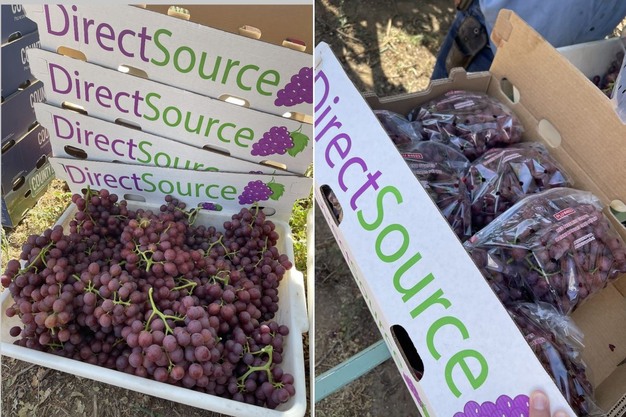
It's a dynamic scene in the table grape world. Mexico's season is winding down and while California is going strong, preparations for imports from South America are already taking place. Starting with an update on California, the state is experiencing a fantastic table grape season due to favorable summer weather. By the end of July last year, the state's table grape growing region had already endured 20 days of temperatures well above 100°F. "This really compromised the grape crop," says Ira Greenstein with Direct Source Marketing. This year however, temperatures are much more favorable. Daily highs this week are around 90°F and lows are in the mid-60s. "It's exceptional table grape weather, resulting in strong volumes and very good quality." This bodes particularly well for some of the later varieties. If Mother Nature continues to cooperate, the total California production volume may reach over 90 million boxes, which is in line with current projections.
 © Direct Source Marketing
Consumer support
Unfortunately, the support from retailers and consumers isn't great. "There is still lower quality Mexican fruit on the shelves that consumers don't want to buy," commented Greenstein. "In the past four to six weeks, quality of Mexican table grapes has been average at best." Consumers need to regain confidence and be convinced the fruit from California is of exceptional quality as that would allow business to pick back up. "I expect to see a change in the next two weeks, which will result in an increase of consumer support."
At least, let's hope consumer support will increase. California growers had to raise contract pricing due to higher costs of production, and it is uncertain whether consumers will support the higher cost of table grapes or not. Last year, contract prices of California table grapes averaged between $22 and $24/box. This year, that price ranges from $24 to $26. Given that consumers have a lot of alternative fruits to choose from this time of year, they are expected to look for the best quality at a value price.
Reduced volume from Chile and Peru
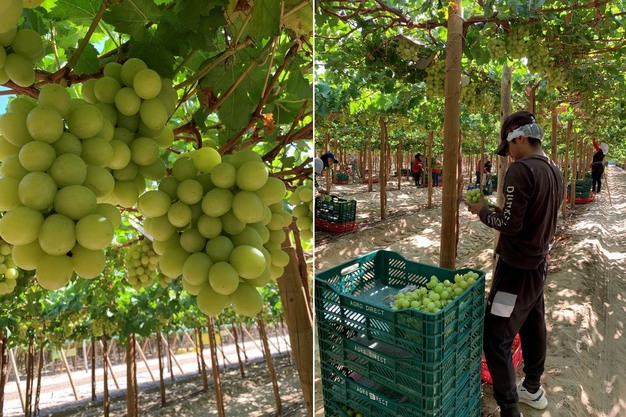
While South America's table grape season is still months away from starting up, U.S. importers typically finalize their programs in terms of projected volume this time of year. Based on recent conversations it has become evident that South American growers are diversifying their volume away from the U.S. market this upcoming season. Chile and Peru typically export about 50 percent of their table grape volume to the U.S., but last year's oversupply led to poor results for growers. Combined with a 10 percent tariff, growers will send more fruit to Mexico, Europe, Asia, and other Central American countries. "The drop won't be outrageous because Chile and Peru can't eliminate the U.S. market entirely. However, it will be enough to prevent oversupply into the U.S. market this upcoming season," commented Greenstein. The tariff can make a difference between a grower being profitable or not. The price difference between a box of grapes FOB origin and FOB USA is about $10-$12 and this is caused by shipping costs, a 10 percent tariff, etc. A South American grower needs about $16-$18 FOB origin per box to breakeven. For a grower to be profitable, this means a box of grapes needs to be sold for $28 - $32, equaling an average retail price between $2.99 and $3.99/lb. The question is whether the U.S. consumer will support the higher cost at retail.
 © Direct Source Marketing
Brazil will shift focus to domestic market
As of right now, Brazil is subject to a 50 percent import tariff into the U.S. and growers would need to receive $20/box FOB to be profitable. This translates into a retail price of $4.99/lb. "It's too risky to guarantee Brazilian growers a price of $20/box and for that reason, they won't be sending fruit to the U.S. market this fall," shared Greenstein. In previous years, the country used to ship about five million boxes of table grapes to the U.S. in November and December, but that fruit won't come this year. Brazil has one of the best domestic grape markets in South America and will keep more fruit closer to home. In addition, Europe remains an important destination. By August 1, there will be more clarity. However, anticipating on what's coming, Direct Source Marketing has already made the decision to abandon their Brazilian table grape program this year as tariffs create too many roadblocks.
 For more information:
Ira Greenstein
Direct Source Marketing
Tel: +1 (914) 241-4434
[email protected]
www.directsourcemktg.com