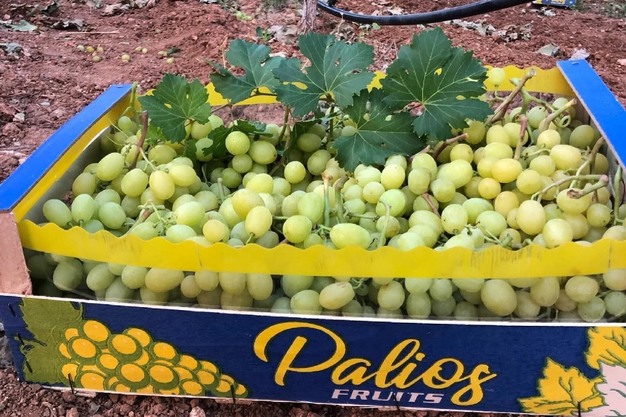
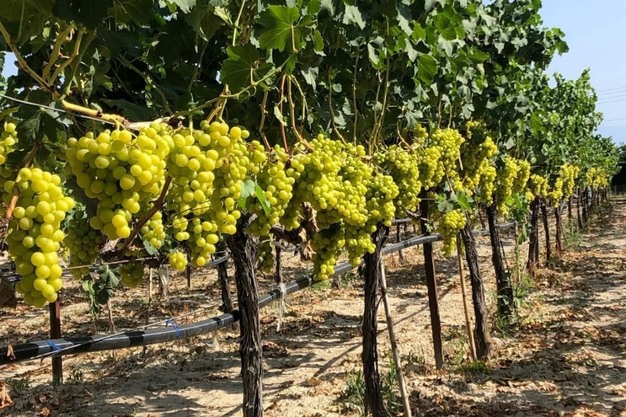
The grape harvest in Corinthia, Greece, is entering its third week, but yields remain low. "At the moment, we are harvesting the Prime and Starlight varieties and getting 15 to 20 tons per hectare. These are low yields that have been caused by the adverse weather conditions. Although rainfall was higher this year compared to previous years, the water received by the vines was still not enough, while irrigation capacity in Corinthia is limited," says Mr. Theodoros Palios, owner of the local packing company Palios Fruits.
At the same time, however, producers are receiving high prices, albeit with significant variation. Specifically, according to the Greek trader: "Demand fluctuates, but producer prices generally range between 1,50 and 1,70 euros per kilo. Prices as high as 2,00 euros have also been reported. The strongest demand is coming from Balkan markets. Germany is also of interest to us, but it is hard to say how the situation will develop, as it seems quite peculiar."
 © Palios Fruits
In the coming days, the composition of the Corinthian grape basket will begin to change. "Next week, we will start harvesting the Superior variety, and in about 15 days, the Sultanina (Thompson Seedless) will follow. A little later, the late-season patented varieties such as Sugar Crisp and Sweet Globe will hit the shelves, but local production of these varieties is limited," Mr. Palios explains.
Thompson Seedless is the dominant variety in Corinthia, but there are concerns about potential quality issues. According to the Greek trader, two main factors are undermining this year's Thompson Seedless crop: "On the one hand, there are many abandoned vineyards, which are breeding grounds for diseases that spread to neighboring productive vineyards. This drives up cultivation costs and may also reduce the grapes' post-harvest shelf life, causing losses in cold storage."
 © Palios Fruits
"On the other hand, we have already experienced several days of particularly high temperatures, and there is a risk that when the Thompson Seedless vines are supposed to develop color and increase brix levels in the berries, they may instead start drawing the juice back from the clusters in order to survive," Mr. Palios concludes.
For more information:
Theodoros Palios
Palios Fruits
Tel: +30 27410 55600