From late June to early July marks the ripening and market debut of Hainan durians in China.
"We are still focusing on durian promotion and tasting events this year and have not yet officially begun commercial sales. This is related to our planting strategy and this year's weather," said Mr. Wei Changxing, Sales Director of Youqi Agriculture, which operates over 866 hectares of durian plantations in Hainan.
"Just like last year, we continue to implement a strategy of 'hiding the fruit nutrients in the ground'—intentionally limiting fruit production to preserve nutrients for tree development. This allows the trees to grow stronger and bear better fruit in the coming years," Mr. Wei explained. "Currently, about 266 hectares are fruiting, and we expect that to increase to 400–466 hectares next year, with an estimated output of 80,000–100,000 durians, enabling us to reach mass production." The current varieties include Monthong, Musang King, Kanyao, and a small quantity of Black Thorn, with Monthong being the dominant variety.
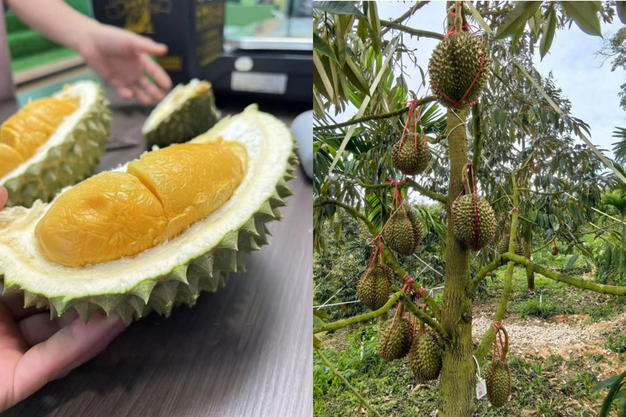
"We trained our durian cultivation team in Thailand and brought them back to manage our base. Our plantation follows standardized management practices and uses our patented organic fertilizer; each tree receives about 300 kg annually. The resulting durians are deeply yellow, with a sweet, caramel-like flavor rarely found in imported fruit," Mr. Wei said. The plantation has already received GAP certification and is expected to gain organic agriculture certification next year.
In terms of climate challenges, Super Typhoon Wutip, which struck Sanya in mid-June, had a substantial impact on many fruit crops, including durian. "June typhoons are rare in Hainan, so farmers had little time to prepare. We originally had 20,000 to 30,000 durians nearly ripe, but the storm reduced the number of harvestable fruits to just 8,000–10,000," said Mr. Wei.
Challenges and advantages of Hainan durian
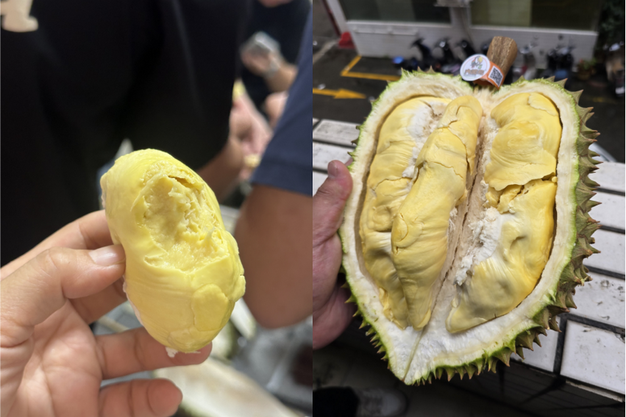
Discussing the current state and challenges of Hainan's durian industry, Mr. Wei pointed out that poor fruit quality from individual orchards is often due to inadequate planting and management techniques: "These are not our partner orchards. Some independent growers rush to market and harvest durian from immature trees, resulting in low-quality fruit. Post-harvest processing is also often neglected. For example, Monthong durians should be sorted and processed carefully, with water rinsing, fermentation, and temperature control steps. However, some orchards ship fruit immediately after harvest, causing issues like underripe flesh, fruit that won't open, and pale meat. Last year, such quality problems hurt the market reputation of Hainan durians. In addition, some orchards overuse fertilizers and pesticides, and have inconsistent management practices, leading to poor-tasting fruit," he added.
"Of course, there are well-managed orchards with good practices, but they remain the minority. Local government departments are paying attention to these problems and hope our company can help raise the overall standards of the industry," Mr. Wei noted.
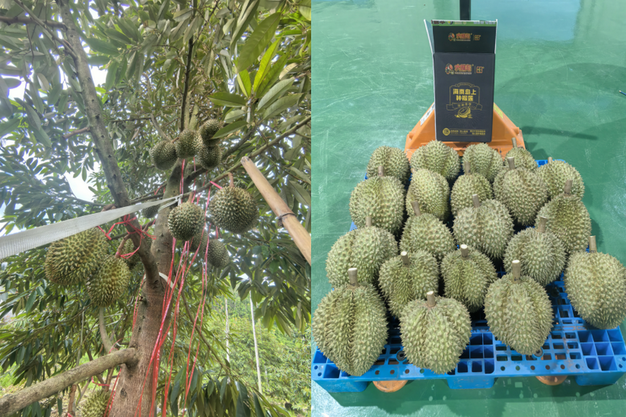
On the bright side, he emphasized several clear advantages of domestically grown durians:
"Hainan durians are harvested at about 95% on-tree ripeness. They have higher starch content, lower water content, and a sticky, rich texture. Because they are grown domestically, they don't require long-distance transport or preservatives, resulting in fresher fruit."
To further leverage these advantages, Youqi Agriculture continues investing in post-harvest infrastructure. "We're working with airlines to secure air cargo space and building warehouses in major cities. Our goal is to pick the durians in the morning and deliver them to the sellers' warehouses within 24 hours. In July, we'll also complete our fully equipped fresh durian processing facility, which includes NVIDIA's AI screening machine. This system can precisely evaluate flesh yield and detect insect damage or spoilage, making it China's first durian production line."
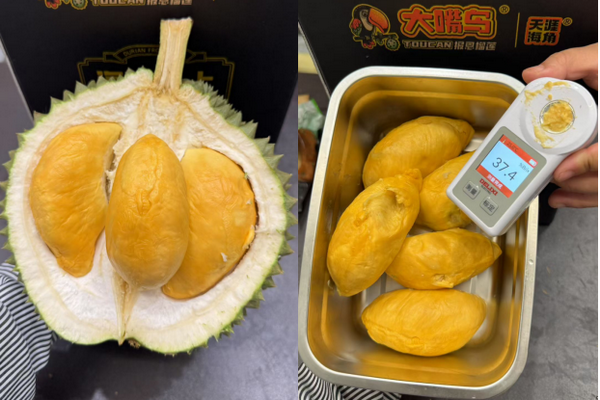
Youqi Agriculture markets both domestic and Thai-imported durians under the "Dazuiniao" brand and four sub-brands. "In Thailand, we operate orchards and require the durians we sell to meet high standards: a starch level of 38 and sweetness of 36. However, due to weather conditions over the past two years, few fruits meet these specs. We currently import about 1,600 boxes of Thai durians each week."
Youqi Agriculture will also participate in the Durian Industry Seminar in Sanya, Hainan, from July 18 to 20.