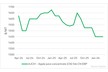
The volume of South African apple arrivals has increased recently, causing the price to drop from over ¥300 per box to around ¥270–¥290 (US$1.67–US$1.80) per box. The quality of arrivals is good, and overall performance is better than last year. It is understood that in the previous season, South African apples suffered significant losses and poor quality, which led to selling prices falling below ¥200 (US$1.23) per box.

South African apples
Regarding South African citrus, it is noted that compared to the same period in previous years, the arrival volume of South African oranges has decreased significantly, while the arrival of South African mandarins has increased substantially. In particular, the Honey Murcott and Nadorcott varieties of South African mandarins have arrived earlier than in previous years, and in large volumes, which has impacted the sales of Peruvian and Australian mandarins. The Peruvian mandarin season has started, but current arrival volumes remain low.

Left: Australian mandarins; Right: Thai mangosteens
Currently, the price of Seedless Afourer mandarins is similar to that of previous years. Depending on the size, the purchase price for a 9KG box on one pallet is around ¥140–¥160 (US$0.86–US$0.99). These are mainly sold to northern markets. Traders noted that arrivals are expected to gradually decline. The Honey Bee Murcott variety still has limited arrivals. After being re-selected and repackaged, the quality and pricing of these mandarins are comparable to previous years. Some traders mentioned that due to abundant lychee production in China this year, along with lower prices, many consumers now prefer lychees, which has affected the sales of other fruits.
Thai mangosteens continue to arrive steadily, with prices remaining largely unchanged from the previous two weeks. Traders stated that buyers are increasingly focused on fruit quality, and size specifications are no longer the main consideration.

Left: Xinjiang Diaogan apricots; Right: Guizhou honey plums
As for domestic fruits, those currently on the market include Guizhou honey plums, Dali winter jujubes, Xinjiang Diaogan apricots, and grapes. Guizhou honey plums have been available for the past two weeks. Unlike last year, when prices rose due to reduced production, this year's prices have dropped by about 20%. According to traders, continuous rainfall in Guizhou has affected both the taste and shelf life of the honey plums, leading to lower prices. The arrival volume of Dali winter jujubes has increased significantly, and while prices have dropped, the quality and taste remain good. Traders selling domestic fruits noted that overall sales are currently slow, with Xinjiang Diaogan apricots performing relatively well. Due to weather conditions this year, the fruit size is more uniform, and the quantity of large-sized apricots is limited.