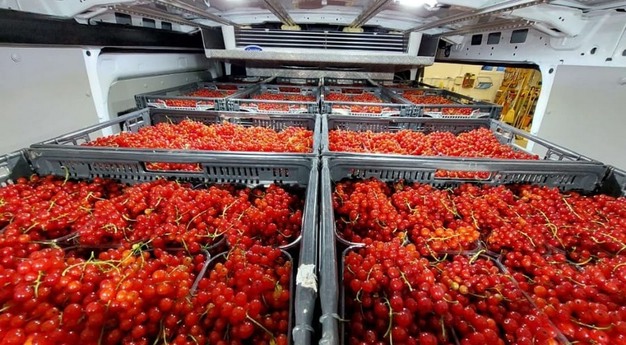
This year's currant harvest at the Knöbl farm was already completed on June 24. "Last year, we even finished ten days earlier. But even this year, we still have a few days' head start compared to an average year," reports owner David Knöbl, who has been growing the red berries on around 1.5 hectares for four years. When asked, Knöbl reveals that the key to the early start to the season lies primarily in the choice of variety.
Raised on his parents' fruit farm in Neudauberg in Burgenland (on the border with Styria), Knöbl was looking for a new crop to complement the tried-and-tested apple cultivation after graduating in 2020. That's when he came across currants. Instead of the usual Rovada or Haronia varieties, Knöbl opted for the then-new early variety Marlena. A risky but successful decision, he concludes. "Our currants are picked within eight to twelve days. Accordingly, the harvest and marketing window is relatively short, but market prices are fairly firm and stable." Knöbl points to the low competitive pressure in the early season. "The harvest of domestic Haronia, for example, is only just getting underway, while we are already finished."
 © Knöbl Obsthof
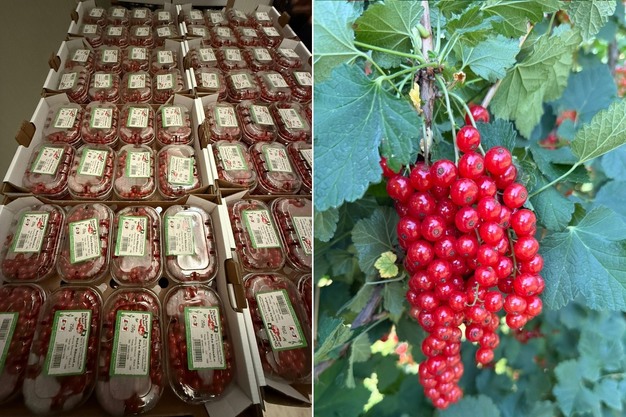
Left: Packaged currants for Austrian food retailers. The fruit is available in 250g punnets from full-range retailers, while discounters mainly sell it in 500g punnets. Right: Freshly harvested currants
Regional currants become established
The produce is marketed throughout Austria via the marketing partner Lammer Fruchtlogistik GmbH, both to discounters and full-range retailers. Knöbl: "The food retail trade ordered around 20 percent less produce this year. In this respect, demand is somewhat more subdued compared to other years. Prices are currently at the same level as last year and are satisfactory for us as producers." Although most food retail chains also offer imported produce during the domestic season, regionality is very important, according to Knöbl. "Our produce is listed in the 'Da komm ich her' (en: That's where I come from) regional range, and its regional origin is also highlighted at the point of sale."
 © Knöbl Obsthof
Austrian Marlena currants will be available until calendar week 27.
Good, stable market niche
Knöbl also sees further potential for domestic currants in the long term. "The product has established itself well in recent years. I don't rule out the possibility that we will expand our cultivation capacities somewhat in the medium to long term. In that case, however, I would only plant the Marlena variety, as we have found a good, price-stable market niche here. Growing a later variety would therefore be out of the question for me. An additional advantage would be that I could keep my pickers employed throughout the year by harvesting alternately in both orchards. However, from next year, we will no longer be allowed to use the plant protection product Movento from Bayer. So I would like to wait and see how things develop before making any decisions."
 © Knöbl Obsthof
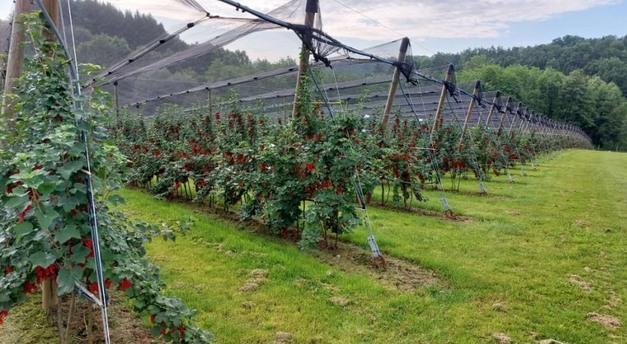
The plantation is equipped with hail nets and drip irrigation. The fruit only needed additional watering during flowering.
For more information:
David Knöbl
Obsthof Knöbl
Gemeindestraße 9
7574 Neudauberg
Tel: +43 664 8685730