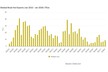
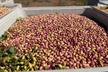
Just over half of the world's almond production traditionally comes from the United States, mainly California, where the dry climate and irrigation infrastructure allow large-scale cultivation. In 2003, the U.S. harvested around 1.8 million tons, accounting for 51% of the global supply. Other major producers, with annual outputs ranging between 100,000 and 300,000 tons, include Spain, Australia, Turkey, Morocco, Syria, and Iran, according to FAOSTAT.
Looking at that list, it's hardly surprising that almonds are also grown in Georgia, nestled between Turkey and Iran. However, with a yield of only around 2,000 tons in 2023, the industry there is still in its infancy. But things are moving fast. Based on data from Georgia's Rural Development Agency, yields could rise to 10,000 tons in the coming years, primarily for export.
Tornike Mchedlishvili of Geo Nushi has seen the potential. In the arid region of Sagarejo, in eastern Kakheti, he is blazing a trail in Georgian almond cultivation. He started in 2021 with a 25-hectare organic plantation, and has since doubled the acreage.
 © FreshPlaza
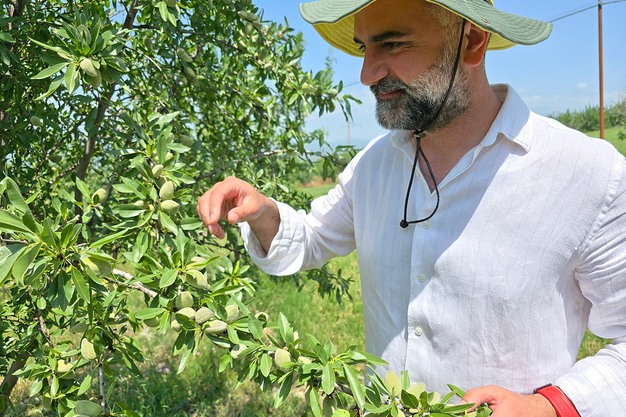
Tornike Mchedlishvili, looking at how the almonds grow on the trees in early June
Interestingly, Tornike didn't draw inspiration from nearby Turkey or Iran, but from Spain—the world's second-largest almond producer. A Georgian friend of his owns an organic olive and almond plantation in Málaga, southern Spain. That friend told him, "Use my plant stock. I'll even help you market the product in Spain if needed."
Spanish know-how
Since then, a Spanish cultivation expert visits Kakheti every two months to inspect Tornike's orchard. "She checks what's needed—what natural products to use, how best to prune, and so on. In between visits, I send her photos of the trees every week," says Tornike.
Geo Nushi grows two almond varieties: the French Avijor and the smaller, sweeter Penta. "Avijor is larger and better for processing, while Penta is ideal as a snack." Both varieties bloom late, late March to early April, a deliberate choice: "It can still be -3°C here in February, and we sometimes get snow in March." To protect against late frost, Tornike uses sulfur-based treatments. The biggest threat, though, is hail in April.
 © Geo Nushi
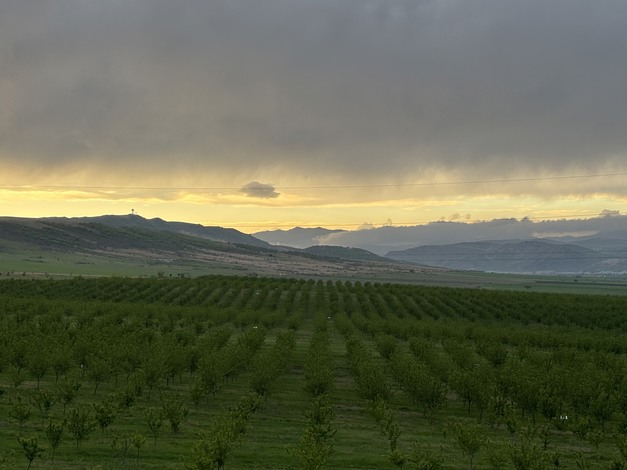
Geo Nushi's almond plantation at sunset
Organic farming on a shoestring
Last year, Geo Nushi harvested 50 tons of almonds from 50 hectares, intending to reach 3 tons per hectare in the next few years. "Conventional farming can yield up to 5 tons, but it comes with higher input costs, mostly from fertilizers," Tornike explains. His operation already breaks even, and he expects to turn a profit by year seven. "Trees remain productive for about 15 years before yields start to drop, so this is a long-term game."
While the Georgian government provided subsidies for planting, organic inputs are still hard to come by: only four types of certified organic fertilizers are currently available in the country. "I use sheep during the winter to naturally fertilize the soil. We also return the almond shells to the orchard. It's a circular approach."
Although almonds thrive in dry climates, timely irrigation is essential. And just like in California—where almond farming is under pressure due to water shortages—water availability is a concern in Kakheti too. "In summer, each tree gets 20 to 25 liters of water every three days via drip irrigation. I'm planning to build a reservoir next year, since April and October are also critical months. Fortunately, we had enough rain this April."
Tapping into the European market
While a significant share of global almonds is sold as snacks, in countless variations: raw or roasted, with or without oil or salt, blanched or natural, the real growth lies in processed products: Not only in confectionery, chocolate, and cosmetics, but also in almond milk, flour, and paste. Worldwide demand is rising.
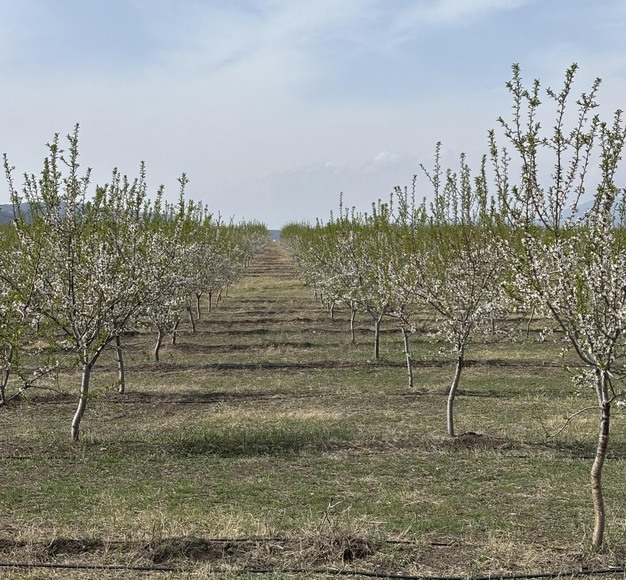 © Geo Nushi
Flowering of Geo Nushi's almond trees in the eastern part of Georgia
Geo Nushi aims to serve both segments, focusing especially on exports to German-speaking countries—markets where Tornike can communicate fluently and where organic demand is strongest. The first shipment to Switzerland went out last year. "And for this autumn's harvest, I'm already seeing interest from clients in Hamburg and Berlin." The ten-day truck journey from Georgia to Western Europe poses no problem for almonds.
Organic almonds in Georgia fetch around 50% more than conventionally grown ones: €7–8 per kilo (shelled), compared to €5 for standard. In Europe, organic accounts for about 8% of the total almond market, a share that continues to grow. While U.S. almonds remain the cheapest, European buyers often prefer local produce for its origin story.
Looking ahead
After the two-week harvest in early September—handled by a seasonal crew of around 20 workers from neighboring Azerbaijan—Geo Nushi continues processing for another two weeks. The almonds are shelled by an Italian machine capable of 500 kilos per hour, then packed in 25-kilo bags, with vacuum packaging as an option.
But Tornike's ambitions don't stop at raw almonds. "I'm thinking about consumer-ready packaging for the Georgian market, and about further processing—blanching, pressing oil, making almond flour." He's also considering an agritourism project and planting walnuts. A visionary, no doubt. "There's no real organic mindset here in Georgia yet," he says, "but it's coming. And when it does, I'll already be miles ahead."

For more information:
Tornike Mchedlishvili
Geo Nushi
18a Fanaskerteli
Sagarejo (Kakheti) - Georgia
Tel: +995 55 78 47 997
[email protected]