Prices for the majority of fruit and vegetable products declined in Switzerland starting in November 2024. This is according to data collected by the BLW. There were significant price declines for carrots and apples, for example. As these form a significant proportion of purchases, this has a major impact on the value of the shopping basket. Kiwis are among the few products whose prices from February to April 2025 were significantly above the average for 2014–2023. The price of individually sold kiwis rose to over CHF 1 (1,23 USD) per piece. However, packaged kiwis containing smaller fruits at significantly lower prices per piece were also available. For comparison purposes, the shopping basket contains four individual fruits and therefore records higher kiwi costs.
 © BLW
© BLW
Shopping basket on a downward trend
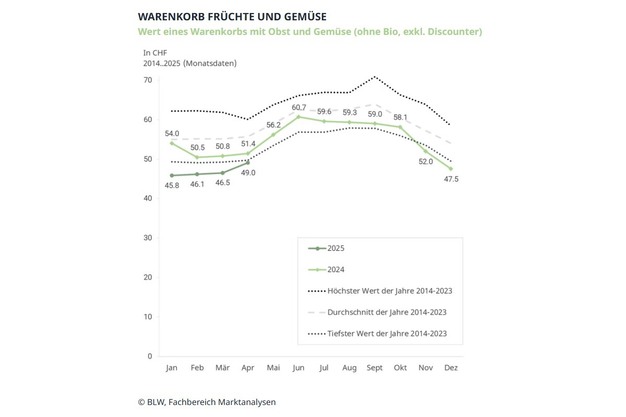
Compared with the previous ten years, 2024 was already a favorable year. The value of the shopping basket was lower every month than the average for the years 2014–2023. In 2024, the shopping basket cost an average of 54.8 Swiss francs (67,54 USD) over the year as a whole. However, 2024 was not the cheapest year. In 2021, the shopping basket cost even less at 53.7 francs (66,19 USD). Since then, the shopping basket has remained well below the 57-franc mark (70,25 USD). Industry experts attribute this to increased price pressure in the retail sector: the market share of discounters rose steadily during the period under review, and traditional retailers responded with price cuts. In addition, some retailers marketed certain products, such as iceberg lettuce and celeriac, exclusively in the low-price segment during certain periods.
Inflation made itself felt
Looking back a little further, it becomes clear that the value of the shopping basket rose by 0.6 percent to 54.0 francs (66,55 USD) in 2022 compared to 2021, and by a further 3.8 percent to 56.1 francs (69,14 USD) in 2023. In general, fruit and vegetable prices are strongly influenced by the supply situation. Weather conditions are an important factor here. However, the supply situation can vary greatly for each product, as some products come from domestic sources, others from abroad, some from storage, others from the field or from greenhouses. However, there is one common factor for all products: inflation rose significantly both domestically and abroad during this period. As a result, the cost of food production also rose. It is therefore noteworthy that, despite this increase in prices, the fruit and vegetable basket remained below the level of the 2010s.
Source: BLW