In the Spanish municipality of Cieza, in the heart of Murcia's fruit-growing areas, there is a stone fruit species that is gaining ground each season. Nectarines are the most demanded, followed by flat peaches, yellow (pavía) or red peaches, and plums. Plums and apricots have lost a lot of share due to the increasingly hotter winters and the fact that most of the trees planted are not self-fertile.
According to José Antonio Gómez, manager of Viveros José Antonio Gómez, "nectarines are the most demanded because they combine flavor, color, and good post-harvest qualities. It's worth highlighting that they deliver the flavor of traditional fruit, with more than 12º Brix. They are sub-acid and have just the right flavor to make them appealing. For a few years, we have all come across fruit without much sweetness, but great progress has been made in variety development, and the product currently has all the necessary qualities."
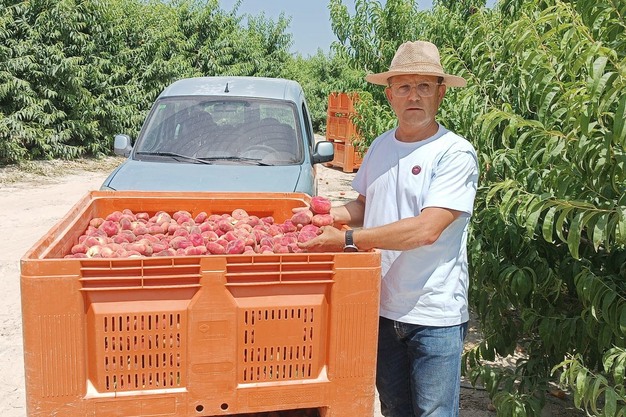 © Viveros José Antonio Gómez
The manager stresses that "the post-harvest qualities have played a decisive role, as nectarines can spend between 7 and 10 days in transit and stay in perfect condition. They don't go soft, and their color remains attractive. What's more, they don't need to be peeled and there is practically no cracking."
The new varieties are aiming for more sweetness, but balanced with acidity. "This doesn't mean uniformity in terms of flavor, as in northern Europe, they prefer fruit that is both sweet and sour, and in the south, sweet and sub-acidic. Preferences also vary depending on the fruit. For example, consumers tolerate acidity in nectarines, but not in flat peaches."
As far as the pavia peach from Cieza is concerned, Gómez says that "it has a Protected Geographical Indication, PGI, and is highly regarded as a traditional variety. Which is why it is resisting market trends. It remains present thanks to its balanced sweet and sub-acidic flavor, which has appealed to consumer tastes for years."
Faced with the possibility of nectarines displacing peaches on the supermarket shelves, Gómez says that "even with nectarines taking a 70% share and peaches 30%, I believe they will always be displayed together."
The future of apricots
Winters are getting warmer, and "apricots are losing ground because of a lack of winter rest. There are problems with the setting and flowering, and production losses are significant. Added to this is the fact that, unlike peaches, nectarines, and flat peaches, most of what is planted is not self-fertile," says the manager.
According to Gómez, new apricot varieties "are self-fertile and tolerant or resistant to sharka (PPV), which is a virus that typically attacks this species. An apricot with sharka cannot be marketed. The fruit is deformed and causes any other fruit it touches to rot. After the hailstorm in May, many trees will be uprooted and replaced by new varieties."
 © Viveros José Antonio Gómez
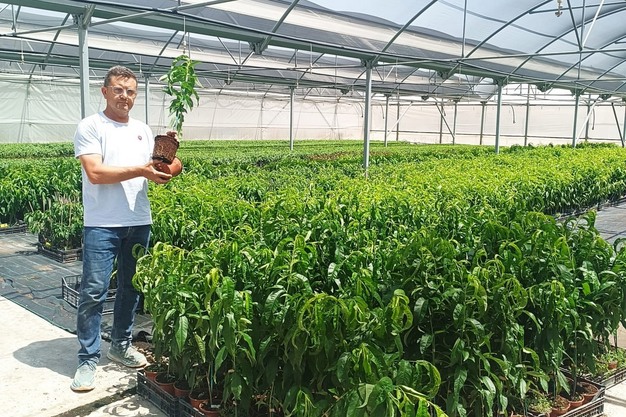
400,000 plants are sold by Viveros José Antonio Gómez each year, mainly in the Region of Murcia, Badajoz, and Lleida. What helps them stand out, according to Gómez, is that "all the plants are grown in pots using micro-grafts. This allows us to do three rotations a year with a relatively small production area totaling 12,000 square meters."
Another important point is that "the plant doesn't touch the soil during any stage of development, thus avoiding problems with soil pathogens that could cause root disease, such as Agrobacterium tumefaciens, nematodes, and others. We only transplant to the field at the optimum time for the tree. We do that all year round except for July and August because of the heat. At the nursery, we keep temperatures, solar radiation, and relative humidity under control. The technology is good, but those of us working at the nursery are the ones ensuring the most accurate control of all these parameters."
For more information:
José Antonio Gómez
Viveros José Antonio Gómez
Tel.: +34 605 67 65 75
[email protected]
https://www.facebook.com/viverosjoseantoniogomez