The black-red federal government intends to raise the minimum wage to EUR 15. This would mean that strawberry farmers would also have to pay their mostly foreign seasonal workers (the majority of whom come from Romania) EUR 15 per hour. According to the Association of South German Asparagus and Strawberry Growers, this is not feasible for many farms, as stated in response to an inquiry from the Münchner Merkur newspaper.
Saxony: Bountiful yields expected
This year's strawberry season has now officially opened in Saxony at the Obstgut Genossenschaft Seelitz (OGS) farm in central Saxony. After the crisis year of 2024, with extreme frost damage, fruit growers are anticipating good yields this time around. A harvest of 1,500 tons is expected. At the same time, however, there are also concerns in the industry – the area under strawberry cultivation in Saxony continues to decline. This year, they are still being grown on 175 hectares. According to association figures, last year the figure was 208 hectares, and at the beginning of the 2000s it was 600 hectares or more.
"The weather hasn't caused us any major problems this year," said Jörg Geithel, chairman of the Fruit Growers' Association of Saxony and Saxony-Anhalt, at the start of the season. The recent cool temperatures have delayed the ripening of the strawberries somewhat, but this will not affect the quality or quantity.
Hesse: First raspberries from protected cultivation
At the Wetterauer Früchtchen farm in Münzenberg, the strawberry harvest is now in full swing in the open field, reports farm owner Maximilian Reuhl, whose fruit is sold at Tegut markets, among others. Reuhl is currently quite satisfied with both the yield and sales of his strawberries. In calendar week 22, the first raspberries from protected tunnel cultivation were also harvested. However, these are still very small quantities, Reuhl told FreshPlaza.de on request. The market is still highly competitive and competition from low-cost producers such as Morocco is fierce, he added.
North Rhine-Westphalia: 'Early availability of regional strawberries comes at a price'
In North Rhine-Westphalia, the strawberry harvest began particularly early this year. This was due to the sunny weather in March, according to Bernd Möllers from the North Rhine-Westphalia Chamber of Agriculture. However, the early availability of strawberries in North Rhine-Westphalia comes at a price. According to the Agrarmarkt Informations-Gesellschaft (AMI), the price per kilo is currently EUR 8.19 on average. By way of comparison, the fruit cost EUR 8.08 in the same period last year. The average price in 2024 was EUR 6.69.
Of the approximately 340 strawberry farms in North Rhine-Westphalia, more and more are turning to protected cultivation. While 1,600 hectares are cultivated in the open field, 500 hectares are now under plastic tunnels or covers. "The trend is continuing toward protected cultivation," Möllers notes.
Saxony-Anhalt: Search for temporary workers is becoming more difficult
In the Burgenlandkreis district, the strawberry season has begun for producer Martin Beck, and with it comes the major logistical challenge. Without harvest workers from abroad, many farms would not be able to cultivate their fields at all. Since the war in Ukraine, the origin of the workers has shifted, and qualified personnel are becoming scarce.
Bavaria: Cultivation in raised beds is rapidly gaining importance
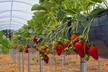
The strawberry harvest is now in full swing on many fields in Bavaria, even though May has been quite cool so far. "Things are really picking up now," says Benedikt Gänger from the Bavarian Commercial Fruit Growers' Association in Munich. To make the work easier, farmers are increasingly turning to raised beds – known in technical jargon as soil-independent cultivation. In soil-independent cultivation, racks are set up under sun tunnels, which are metal frames on which the strawberry plants grow at a height of about 1.30 meters, as Gänger explains. The producer grows strawberries on about 45.5 hectares in Niedermotzing (district of Straubing-Bogen), 5.5 hectares of which are soil-independent.
For the Sonner family from Königsdorf (southern Bavaria), strawberry production will soon be a thing of the past. The family has been growing strawberries outdoors for over 60 years. Now this era is coming to an end. Hans Sonner is retiring from the strawberry business. "I don't have a successor," the 68-year-old said when asked. "Otherwise, I would have continued." But the Königsdorf resident can't do without sweet fruit entirely. He plans to continue cultivating a raspberry plantation.
Brandenburg: Partially devastating frost damage to strawberry crops
Despite their great popularity, the area under strawberry cultivation in Brandenburg continues to decline, according to reports at the start of the season on May 26. Only around 150 hectares are currently under cultivation in the open field. By comparison, the area under cultivation in 2017 was 537.2 hectares. Under protective coverings such as plastic tunnels and greenhouses, the area under strawberry cultivation currently amounts to around 21 hectares. Approximately 250 tons of strawberries were harvested here (as of 07/2024). Even in protected cultivation, the area under cultivation decreased by almost half compared to the previous year. The yield of red fruits rose to 122 decitons per hectare with this cultivation method. In contrast, the average yield in 2024 in the open field was only 49 decitonnes per hectare, which is largely attributable to severe late frosts. Therefore, a decline in open-field cultivation is to be expected in the long term.
On the night of May 6, 2025, temperatures unexpectedly dropped to -2.5 °C, with devastating consequences for fruit growing in eastern Brandenburg. "Despite all the protective measures and good variety selection, large parts of our strawberry crop were destroyed by the late frost," says Reiner Matthes of Pomona Gartenbau GmbH & Co. KG. One way to better protect crops against climate risks could be the use of agrivoltaics. This technology combines agricultural use with energy production and could, in the future, cover strawberry plants like a protective roof and be combined with frost protection sprinklers. "There are still only a few test farms, but we are examining strategies and research results to move in this direction," Matthes continues.
Upper Austria: Weather favors fruit size and quality
Outdoor harvesting is now also underway in Upper Austria. "If 70 farming families in Upper Austria are growing strawberries on 320 hectares this year, that means that almost 30 percent of Austria's strawberries come from Upper Austria because there are currently 1,156 hectares of this delicious fruit nationwide," explains LK OÖ Vice President Rosemarie Ferstl. The moderate temperatures and rainfall in May were generally very beneficial for strawberry cultivation, which has had a positive effect on fruit size and quality.