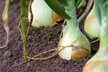
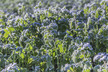
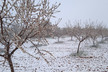
On May 19th, storms accompanied by rain and hail devastated many crops in the Tarn department, including the Lautrec pink garlic crop. Some producers will have nothing to harvest this year. The French minister of agriculture visited the area last Wednesday to assess the damage and promised state aid.
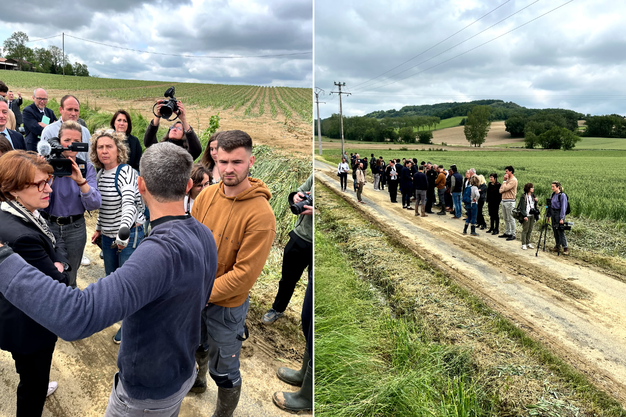 © Chambre d'Agriculture du Tarn
50% of PGI Lautrec pink garlic producers are affected
On May 19th, rain and violent hailstorms hit this southwestern department of France. All crops were affected: cereals, vegetable crops, and the famous Lautrec pink garlic. The losses are considerable. According to the Tarn Chamber of Agriculture, several farmers have lost 90% of their usable agricultural area. "For some, the 2025 season is over."
This is also the case for many producers of Lautrec pink garlic. "We had heavy rain and, above all, a severe hailstorm that lasted nearly 20 minutes, covering 5 km and 20 municipalities," explains Gaël Bardou, producer and president of the Lautrec pink garlic union. "This is an area where a large proportion of PGI producers are located." According to initial estimates, 50% of producers in the PGI area are affected. The assessment of losses is still ongoing, and more accurate data will be available this week. "Producers on the edge of the area are less affected, but some have lost 100% of their crops, so we will only get half the harvest compared to a normal year." This is a disaster for producers and for the sector, "especially as this year's harvest was very promising. We will monitor how the garlic behaves over the next few days," explains Gaël Bardou. A crisis meeting is scheduled for Wednesday to organize the next steps. "We are waiting to see what measures will be put in place by the government. For some, the situation is such that we do not know how they will be able to continue next year."
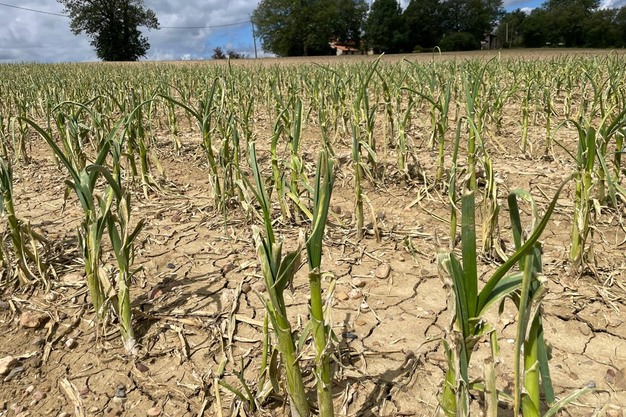 © Gaël Bardou
On this plot of Lautrec pink garlic, "the leaves fell to the ground and were washed away by the water," explains Gaël Bardou.
Annie Genevard announced the implementation of "concrete measures"
On Wednesday, French Minister of Agriculture Annie Genevard visited Lautrec and met with Thierry Bardou, mayor of Lautrec and president of the Lautrécois-Pays d'Agout community of municipalities, who officially requested that the entire municipality be recognized as a natural disaster area. Christophe Ramond, president of the department, also emphasized the need for urgent government measures to help the affected producers.
On BFM TV, the minister announced the deployment of three measures. "We are going to activate the measures provided for in the crop insurance scheme as reformed in 2023, which is the national solidarity compensation in the event of crop losses, as well as the agricultural disaster scheme in the event of fundamental losses (when trees are affected or the soil is damaged). Finally, we will provide cash support to rebuild crops (rescheduling of MSA social security contributions)."
⛈️ I wanted to visit the farmers affected by the bad weather in the Tarn-et-Garonne and Tarn regions immediately.
To express my solidarity in the face of the damage and announce the implementation of concrete measures and emergency provisions to support them...pic.twitter.com/ZQvtFLq6ET
— Annie Genevard (@AnnieGenevard) May 21, 2025
"Adapting agriculture to climate change"
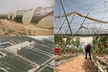
Annie Genevard also mentioned the need to adapt agriculture to climate change, "which will lead us to face increasingly violent and frequent weather events." To this end, the minister reiterated "the importance of ecological planning, greenhouse construction, and orchard renovation. The water that falls in large quantities is sometimes lacking, so we need to be able to store it. Other crops may also be more resistant."
"Countries throughout the European Union are facing violent weather events and crop damage. It is possible to adapt to climate change, and we must do so. The soil must be worked in such a way as to better absorb water, and there must be water drainage systems. We need to look again at the issue of ditch cleaning and river maintenance. We also need to adapt other measures, such as certain climate-adapted greenhouses, to cope with violent weather events like these. Finally, genetics and agronomy are also solutions for improving plant resistance. This is essential because what is at stake here is the survival of agriculture and food sovereignty," announced the minister on BFM TV.