To preserve high-yield soils for food production, multi-use concepts in which food production remains the primary focus and electricity generation provides a second source of income can be a solution that also ensures greater energy independence. The Austrian Chamber of Agriculture, therefore, organized a 'farminar', moderated by Martin Wette, about the "Possibilities of agri-PV for protection against extreme weather events in fruit growing," at which the initial results of the RWA Pöchlarn Fruit and Wine Research Institute, Frutura, and the BOKU University, Vienna, were presented.
"This project came about because Garant, a subsidiary of RWA, has very high electricity requirements," said Klemens Neubauer, Managing Director of RWA Solar Solutions, at the start. The company operates, builds, and develops large-scale photovoltaic systems, with a particular focus on agricultural use. "We then decided that we wanted to install and test several pilot systems for dual use with agri-PV."
 © Landwirtschaftskammer ÖsterreichKlemens Neubauer on site
"We have installed 350 panels here on a steel substructure. The panels consist of two glass modules, which allow sunlight to pass through directly. The panels have a transmission of 35 per cent here; normally, you have 0 per cent," he pointed out. "As for the construction, the panels are installed at a height of about four meters. The system was built in 2020, and we now have about three years of experience with the apple trees we planted here."
Fruit growing under solar panels
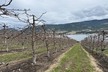
"Here at the Pöchlarn site, we mainly take care of fruit growing matters, including the management of the land," explained Gottfried Dampfhofer, producer advisor and fruit expert at Frutura. To this end, apple trees were planted at two locations—under the PV system and on a reference area—and cultivated conventionally, with plant protection and fertilization carried out according to the standard system. All measures are carried out on both the reference and PV areas. "This reference area is approximately 600 square meters in size and planted with the same apple varieties as the PV area – Gala and Sommernachtstraum."
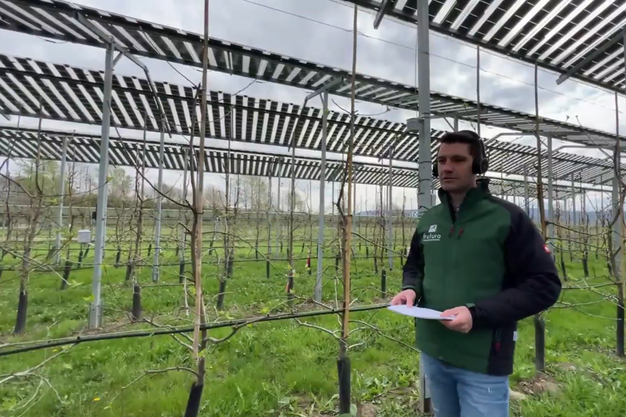 © Landwirtschaftskammer ÖsterreichGottfried Dampfhofer between the apple trees
"All varieties in intensive fruit cultivation are grafted onto special rootstocks so that they can function in this small form," he continued. In addition, the facility has a support structure to prevent the trees from tipping over. "We have covered the upper area of the reference area with hail nets and have drip irrigation." The PV system does not have hail nets to be able to assess whether the panels can also protect in the event of hail. "The aim of production is, of course, to be able to harvest a yield. We are talking about 35 to 40 tons per hectare that we would like to harvest, or rather that must be harvested, for it to make economic sense. Overall, we want to find out to what extent the PV system also works with intensive fruit production and where there could be synergies and antagonisms."
 © Landwirtschaftskammer ÖsterreichView of the system during the farminar
Initially, the growth performance of the trees, the flowering intensity, and the disease pressure were observed on the plots. "We also evaluate severe weather events. To what extent do frost days, drought, and other phenomena have a different effect here than in conventional production systems? We look at the quality of the harvested fruit and record the yields. We evaluate these in terms of quality regarding their commercial usability and then carry out sensory tests – in other words, tastings. And we collect weather data to ensure we have the right data basis," says Dampfhofer.
The second part of the farminar with the initial results of the trials will be published shortly.
For more information: Klemens Neubauer
RWA Solar Solutions
Wienerstraße 72
3380 Pöchlarn AT
Tel: +43 2262/75 55 0 0
Mail: s[email protected]
Web: https://rwa-solarsolutions.at/
 Gottfried Dampfhofer
Frutura
Fruturastrasse 1
8224 Hartl AT
Tel: +43 3334 41800
Mail: [email protected]
Web: https://frutura.com/
 Michael Obriejetan
BOKU University
Peter-Jordan-Straße 82/III
1190 Vienna AT
Tel: +43 1 47654 87422
Mail: [email protected]
Web: https://boku.ac.at/

Martin Wette
Austrian Chamber of Agriculture
Schauflergasse 6
1015 Vienna AT
Tel: +43 (1) 53 441 - 0
Mail: [email protected]
Web: https://www.lko.at/