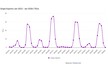
European apricot production is slightly down this year, at 508,291 tons, compared with 536,167 tons in 2024 (-10%). All production areas have been affected by the spring weather (temperatures lower than usual and rainfall), which has affected early varieties and delayed harvesting by 10 to 15 days. However, the hail in Catalonia and frost in Greece could cause forecasts to be revised downwards. Additionally, Turkey, which has been badly hit by frost this year, is virtually absent, which is raising questions and threatening a reshuffling of the market.
 © Marine Inghirami-Benaroch
France: Almost back to normal
French apricot production is back, after a year in which almost 40% of volumes were lost. Forecasts are at 104,785 tons, compared with 79,700 tons last year. Although the alternation phenomenon led us to expect a high level, the supply will eventually be moderate due to rain during flowering, which caused a significant physiological drop. The situation varies widely from one basin to another. In the Pyrénées-Orientales, production is expected to be of good quality with reasonable volumes. All the indicators are good for this season. In the Rhône Valley, optimism is the order of the day. The load on the trees is good, and so is the quality. "Production is steady, with great potential."
By region: Languedoc Roussillon 34,423 tons, Rhône Alpes 52,000 tons, and PACA 18,362 tons, which gives a total of 104,785 tons.
While production is on an upward trend again, France is still a long way from the 150,000 tons it was producing a few years ago. French orchards are no longer growing, they are even shrinking. "No more apricots are being planted, or at least not enough," explains Raphaël Martinez, director of Peaches and Apricots of France. New varieties are appearing (to the detriment of others, such as the Bergeron in the Rhône Valley, which is in sharp decline), but this is done mainly to renew the orchards rather than for new planting campaigns.
Spain: Rain and hail make early forecasts difficult
To date, the forecasts for Spain stand at 136,000 tons, which is stable compared to 2024, but likely to be revised downwards as the frequent and sometimes heavy rainfall during flowering raises questions about production potential after the fruit differentiation phase, currently underway. Additionally, Catalonia was hit by hailstorms last weekend. Agroseguro has only just begun to assess the damage, but initial reports suggest that several hectares were badly damaged.
By region: Valencia 1,200 tons, Murcia 71,500 tons, Aragon 27,050 tons, Catalonia 17,080 tons, Castilla-La Mancha 11,500 tons, and the remaining 7,860 tons, which gives a total of 136,190 tons.
Greece: Production cut by 34% due to frost
This year, Greek production was severely affected by the frost episode of March 21st and 22nd (with temperatures that reached -6°), especially in the north of the country. In Macedonia, where the damage was most severe, up to an 80% loss is expected for early and very early varieties. In the south (Peloponnese), on the other hand, losses are lower, with a slight drop in volumes. With 67,750 tons of production forecast for 2025, Greek production is 34% below the 103,000 tons for 2024, and 16% below the 2019/2023 average.
By region: Peloponnese/Sterea/Crete 31,250 tons, Macedonia and other regions 36,500 tons, which gives a total of 67,750 tons.
Italy: Acreage continues to drop
After a loss-making campaign in 2023 and a return to more normal production levels in 2024 (245,000 tons), Italian production is set to drop in 2025, with forecasts of 199,500 tons, which is 20% lower than last year. Only Campania and Sicily show higher volumes than last year. This drop in production in Italy can be explained in particular by a drop in surface areas (which has been ongoing for several years), but also by unfavorable weather conditions: variations in temperature, rain, and frost, affecting both northern and southern regions. Flowering was good in most production areas, and fruit set was positive, even if weather conditions were not optimal.
By region: Emilia-Romagna 58,008 tons, Southern Italy/Sardinia/Sicily 123,115 tons, and other 18,443 tons, making a total of 199,566 tons.
What about European production in the absence of Turkey?
Turkey, the world's leading apricot producer, has seen its production cut by 70% due to an exceptional cold snap. While the majority of Turkish production is destined for the processing market, a significant proportion is usually exported to Eastern Europe and Germany for the fresh market, which will not be the case this year. This could be an opportunity for European apricots. Tomas Bosi of CSO Italy confirms this, pointing to an open door for Italian apricots to Germany (Italy's leading export market), as well as for French apricots, whose export market has shrunk considerably over the years.