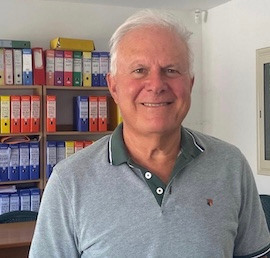
 "In my opinion, the market for fruit and vegetables is at a standstill and prices are at an all-time low. We're not making sales because there's not much to consume, despite the fact that we've lowered the prices to below the cost of production," says Biagio Pulvirenti, president of the Sicilian cooperative OP Agrinova Bio 2000, who adds: "Certified organic lemons cost 0.70 euros per kilogram, and the same applies to oranges, which are also penalised by the failure of the industry to withdraw them due to an oversupply of stored products, but also for other reasons."
"We are processing artichokes and courgettes, while next week we will start with carrots. Production is below the lower limits that characterize organic production due to the drought. The Violetto variety, whose hectares we have halved due to the water emergency, is marketed from November to the end of April, in two cycles (one that ends around 15 February and the other that starts on 1 March). It has been raining lately, but not enough to do any good to the plants. To make matters worse, the volcanic ash is making our Mandarino Tardivo di Ciaculli unmarketable."
"With regard to the volcanic ash falling from Mount Etna, we hope that the policy of supporting producers can lead to a discussion table since volcanic ash is indeed a serious problem that must be tackled by providing assistance to farmers."
The farms of the 55 members of OP Agrinova Bio 2000 cover an area of 616 hectares, of which 55% are dedicated to citrus fruits, about 10% to open field and protected vegetables, 10% to various orchards and nuts, 5% to tropical fruits (avocados), which is gradually increasing as a result of climate change, 5% to olives and the rest to herbaceous crops (15%). The average size of member farms is about 10 hectares. They are often multifunctional, with agritourism and/or educational farms.
"In the context of climate change, we are increasingly convinced of the crucial role of organic agriculture, which is now a question of resilience in the face of the challenges of the third millennium. In particular, Agrinova member companies are able to defend themselves thanks to regenerative crop management. Over the years, this has resulted in soil organic matter levels ranging from 2% to 6%, while the average for Sicilian soils is around 1%, with a process of desertification underway. Soil samples taken on our farms show that the soil is completely dry to a depth of 20 cm. This is why Sicily has been declared an area "at risk of drought and desertification."
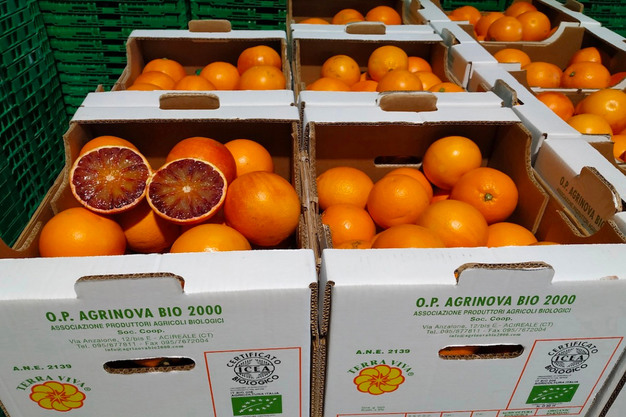
Agrinova Bio 2000's sales channels are specialized shops, local supermarkets, and 40 solidarity purchasing groups, a dozen of which are distributed throughout the Italian peninsula (mainly in the north) and the rest in Europe. Part of the production of citrus fruits is also destined for school canteens, and in recent years e-commerce has been activated in Italy, with delivery within 48 hours of the order.
At the moment, the producer organization generates 50% of its turnover in Italy and the rest is exported to Belgium (19% of the European export value), Great Britain (29%), Germany (9%), Switzerland (15%), France (26%) and the remaining 2% to other countries (Poland, Luxembourg and Greece).
For more information:
Biagio Pulvirenti
OP Agrinova Bio 2000
Via Anzalone, 12 bis/E
95024 Acireale (CT)
(+39) 095 877811
[email protected]
www.agrinovabio2000.it