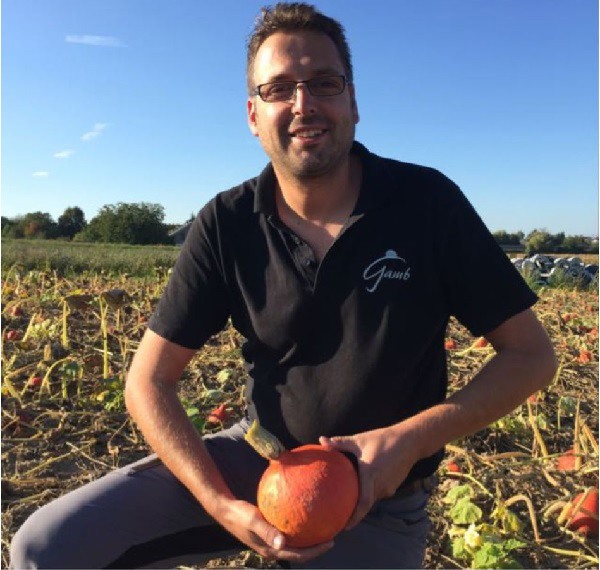
 Pumpkins were a purely seasonal product a few years ago, available from September to November/ December, according to Stefan Gamb, managing director of the farm of the same name in Eschbach in the Breisgau-Hochschwarzwald district. "However, pumpkins are becoming increasingly a year-round item every year, as pumpkins also find their use in the summer. The product can sometimes be sold even at 30 degrees. Accordingly, our acreage has grown exponentially with sales."
150 hectares of pumpkin production
On his own farm, Gamb grows pumpkins on about 150 hectares. "The strongest item is butternut squash, although we also produce Hokkaido and Halloween squash. We are a purely conventional producing farm. But especially with the Hokkaido, organic cultivation has a large share of the market. Increasingly, you also often see full-line retailers displaying both conventional and organic pumpkins of the same variety in the store." According to Gamb, there are also many small farms selling Hokkaido and other pumpkins for direct marketing and on the open market in excess quantities at open prices, which in turn comes at the expense of those farms that exclusively supply wholesalers as well as food retailers.
Crop losses due to weather
"Due to the weather, we have harvest losses of 30 percent for Hokkaido pumpkins. But the yield of butternut is also lower than last year. The quantity of Halloween pumpkins was not bad, although some of the product will not be marketable due to sunburn. Further, pumpkins would trade too cheaply during the peak season. "However, sooner or later the wheat will be separated from the chaff in this product field, as more and more small farms are giving up growing Hokkaido pumpkins," Gamb says.
Price drop in September due to oversupply
"I have a delivery obligation to the chains, which is why I also have to ensure, in consultation with my customers, to obtain pumpkins from other origins if necessary as soon as the German warehouses are empty. However, the focus is on being able to offer goods until next spring. The issue of sustainability plays a very important role for our company. To this end, we want to bundle transport with us and store the products for longer. Therefore, it makes sense not to flood the market with goods in September, but to store as good goods as possible in order to offer customers regional German pumpkins over a longer period of time. If other farms handled it this way, we wouldn't have a problem with the massive price drop in September and October."
Kohlrabi shortfalls of 20 to 30 percent
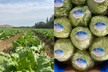
For Gamb's operation, the peak kohlrabi season runs from April through November. "Kohlrabi also runs through that time without a problem, provided there are no extreme weather conditions or pest infestations. Of course, if the heat gets up to 35 degrees, the product can't thrive either. We now plan our summer crops on a larger scale so that we can supply our customers, as we have to expect shortfalls of 20 to 30 percent. That's a circumstance that's also reflected in the price, although we can't always pass on those additional costs."
Labor costs up 40 percent
"It is said that fruits and vegetables have become more expensive, however, in my opinion, prices are still not high enough." He said transportation costs have remained the same as last year, while labor costs have skyrocketed. "The 12-euro minimum wage is paid even to employees with the lowest qualifications. Accordingly, we also have to pay our foremen more, as well as employees at higher levels. As a result, labor costs have skyrocketed by 40 percent. For harvesting kohlrabi, we now have to pay EUR 0.20 per piece instead of EUR 0.10, whereby only wage costs are charged here, not production costs."
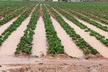
To counter these problems and meet specially set sustainability standards, Gamb is devoting himself to new cultivation methods, such as using mulch films as well as drip irrigation. "In this process, the water is delivered directly to the plant, so that 100 percent of the water is available to the plant. We still want to optimize this area. Another efficiency factor is planting the right variety in the right location at the right time. It is possible to grow pumpkins in a greenhouse, but the question is how economically viable this type of production will be in the end. We strive to make production as cost-effective as possible."
For more information: Stefan Gamb
Stefan und Daniela Gamb Obst und Gemüse Vermarktungs GbR
Gewerbepark Breisgau
Heitersheimer Str. 5 b
D-79427 Eschbach
Phone: +49 7634/503897
Telefax: +49 7634/553113
E-Mail: [email protected]
Website: https://gemuese-gamb.eu