The French melon season began with bad weather causing some difficulties in the southeast region, but from next week onwards, all production basins should be active. “The greenhouse melon campaign on the French market began on May 15th, and at the beginning of June for open-field melons. The southeast basin was the first to go into production, with the PACA, Hérault and Gard regions. The central-western region and the Vendée are now starting their campaign, and the southwest will begin its season next week,” explains Jérôme Jausseran, president of Force Sud.
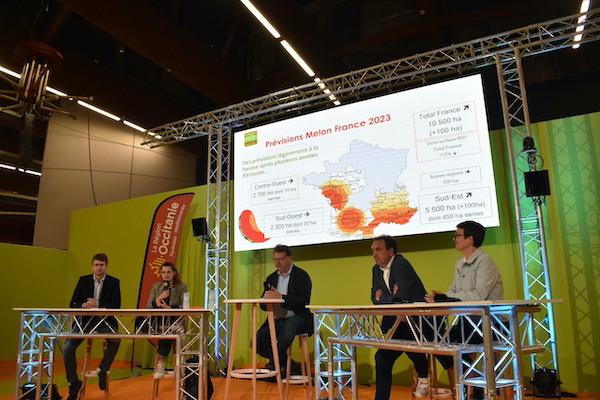 Harvest predictions at medFEL for the 2023 campaign
Storms have impacted the yields
The beginning of the campaign was difficult due to the weather conditions that have affected fruit and vegetable productions and their yields in the south of France since the beginning of June. “Since the start of the season, the supply has been too low due to the storms that have hit the melon fields. The volumes available are well below what they should be, as we are struggling to reach 1,000 tons, while we should be at 3,000-4,000 tons a day around this time of year.”
The dynamic demand generates high prices
The supply is limited, and consumption has been boosted by the much milder weather of the past few days. “We therefore have a tight market, where the supply is too low to cover the demand. This necessarily generates high prices, which unfortunately may not compensate for the lack of yield (divided by 3 or 4). But the situation should return to normal as early as next week, with all the basins coming into production.”
Much improved quality
The quality of the melons has improved significantly since last week. “With all the storms, the first French melons at the beginning of June were of average quality, with a rapid growth and too much water. But with the milder weather, the melons arriving on the market are now becoming very pleasant to eat.”
Less foreign competition in supermarkets
The competition from other origins on the French market has been much more sustainable for about two years now. “French lines were able to open up quickly as soon as the production started in the open fields at the beginning of June, which nonetheless brought in some volumes. Over the past 2 years, the Spanish surfaces have also shrunk to such an extent (-1,800 hectares) that the Spanish supply is now taking up much less space than before on the shelves.”
For more information:
Jérôme Jausseran
Force Sud
[email protected]