Due to the unique characteristics of mushrooms, with their quick growth and limited shelf life, their cultivation requires a high level of technical and planning skills to be able to offer continuity in the supply to the market.
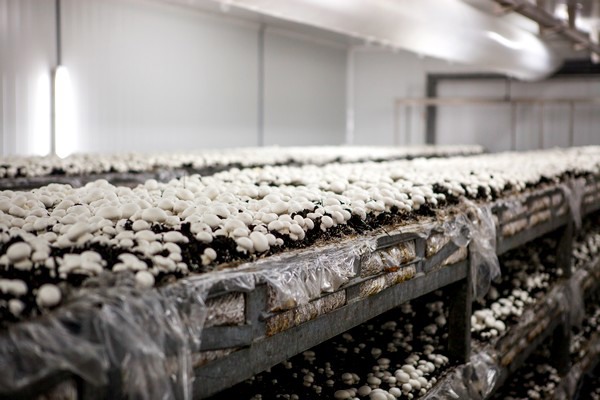
"In mushroom cultivation, as with the rest of the mushrooms we grow at Champinter, we add value to the product by adapting the production to market demand. If supply peaks occur and the market cannot absorb them, the consequence is a drop in prices," says Elías Olmeda, president of the Champinter cooperative society.

Elías Olmeda, president of Champinter.
"We are talking about a very perishable product that is harvested every day. If a mushroom of ours is harvested today, tonight it will already be in a shipment. That's why we try to stagger the production, so that it can be adjusted daily to the demand and customer requirements and the needs in different geographical areas, while continuing to comply with the market's quality parameters. This requires a high level of technification," says Elías, "and Champinter has made great investments in research in refrigeration techniques to optimize our production."
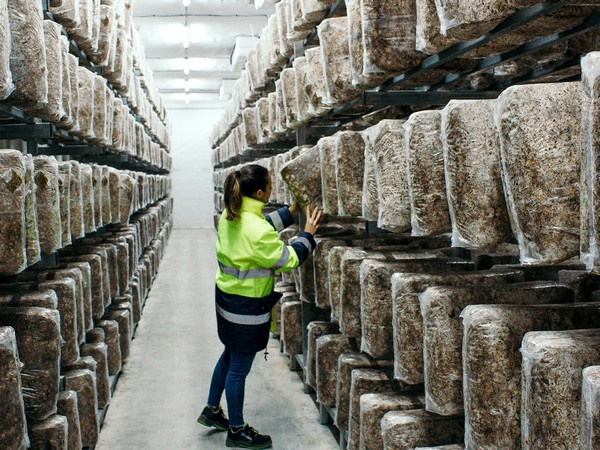
"The mushrooms are harvested at a temperature of 16-18 degrees Celsius, and in order to prevent them from continuing to develop and deteriorate inside the packaging, the growth must be slowed down by applying cold. To achieve this, we have implemented rapid cooling chambers in the facilities of our cooperative members. This allows us to save time, to manufacture the product quicker and to always guarantee its freshness. That way, the product will have a longer shelf life where it matters: in the market."
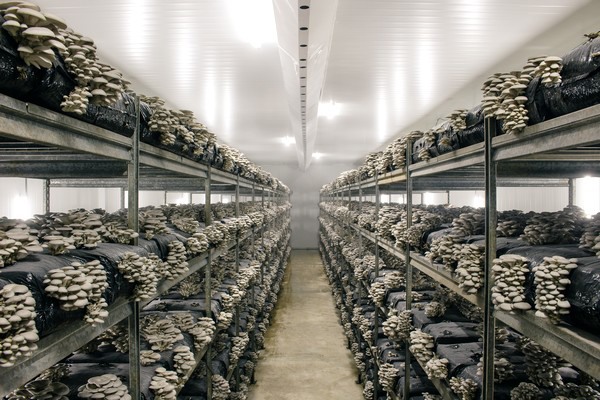
"The demand and consumption of mushrooms and other products, such as the portobello or shiitake, has been rising in Spain. In fact, the latter is gaining ground over regular mushrooms. Since they are grown in controlled conditions and are not subject to climate fluctuations, prices remain stable and are also quite affordable. However, at the moment, there is some product shortage in the market due to rising production costs, which farms are currently unable to pass on to the end customer. In fact, this increase is so high that we believe consumption could be affected."
The cost of the energy needed to maintain the production processes in mushroom cultivation has experienced a huge rise, and this is something that hasn't occurred only in this area. "Packaging and transport costs have also risen sharply, and these are two elements to be taken into account when working with this product," said Elías.
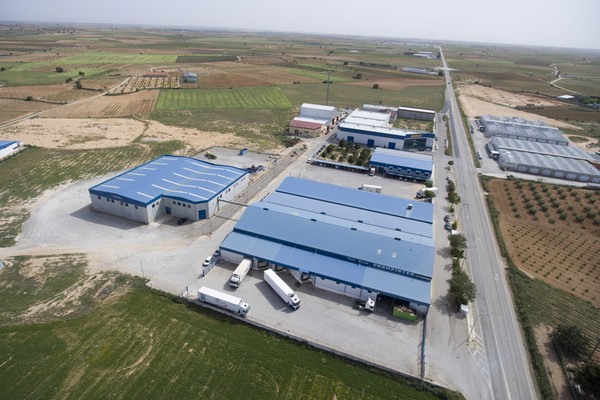
Champinter facilities.
"Champinter's great strength lies in unity, since it is a cooperative, but we know that, at the moment, there are already farms in Spain on the verge of profitability where some sowings are not being carried out, and this will possibly have an impact on the supply. In that case, there may eventually be some price rises, although we will try keeping them as small as possible."
 For more information:
Champinter
Ctra. Cenizate 1
02270 Villamalea, Albacete. Spain
Tel.: +34 967 48 31 41
[email protected]
web.champinter.com