This is now an established event on the eve of medFEL. For the third year running, the melon and peach-apricot sectors, joined this year by the plum sector, met at the Palais des Congrès in Perpignan for the "Summer Fruit Meeting", organized on April 27th, 2026. The aim was to prepare the future campaign with retailers.
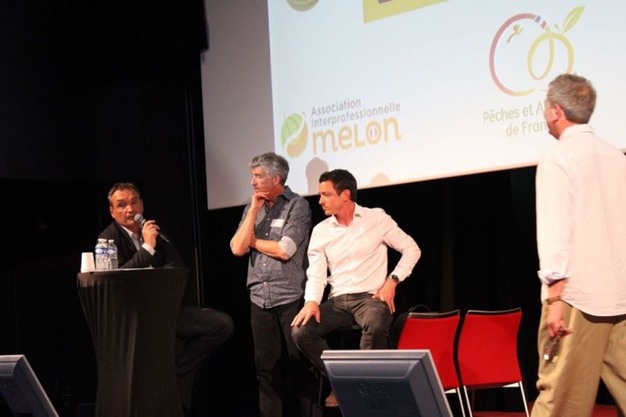 © AOP Pêches et Abricots de France / AIM
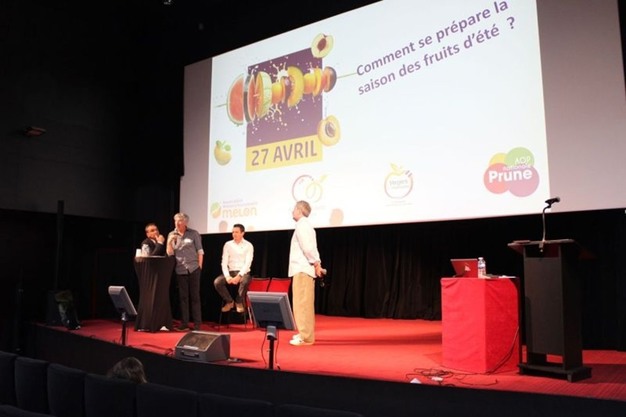
The third edition of the Summer Fruit Meeting brought together more than 250 professionals - producers and distributors - for one evening in order to launch the 2026 campaign. The event was organized by the Peaches and Apricots of France association of producers, the Interprofessional Melon Association (AIM), and this year, the Association of French Plum Producers. The melon and peach-apricot sectors are taking advantage of medFEL to invite distributors to attend and start discussions ahead of the season.
Most of the major French retailers were present, including Intermarché, Leclerc, Carrefour, Auchan and Lidl, as well as representatives of wholesalers such as Pomona, Le Saint and UNCGFL. Coopérative U and Grand Frais, for their part, continued their discussions with the sectors the following day at medFEL. Hosted by journalist Antoine Robin, head of the 'Very Important Farmer' program, who was also involved in organizing the meeting, the debates were structured around the theme of food sovereignty. This was broken down into four areas, identified as the levers of a successful campaign.
Switching between Spanish and French origins
The first lever addressed was managing the switch between Spanish and French origins. This is a key issue for promoting the French product. "We need to put the French origin on the shelves as soon as it is available and of good quality," explains Raphaël Martinez, director of Peaches and Apricots of France. While in the past, some switchovers have proved tricky, the last two campaigns have shown that the transition has gone more smoothly, pointing to a fairly favorable outlook for 2026.
As far as distributors are concerned, this point seems to have been taken on board. "They say they are ready to prioritize the French origin," emphasizes Jérôme Jausseran, vice-president of AIM, who recalls an essential condition expressed by supermarkets, which is "not to mislead consumers." In other words, quality must remain the key factor. "You cannot start too early in the season to meet consumer expectations."
The issue of production costs
The second point addressed was the sharing of production costs. In a context marked by the energy crisis, costs are rising across the board: labor, transport, packaging, inputs and so on. We have calculated an increase of 10 to 15% depending on the product and its yield for the year," explains Raphaël Martinez.
Against this backdrop, the discussions aimed to raise buyers' awareness of the need to take account of production costs. The stakes are clear: avoid selling prices that are too low, which would jeopardize the economic equilibrium of farms. "All sectors are reporting an increase in costs," and yield will also have to be taken into account, particularly with the drop in apricot production forecast for this year.
 © AOP Pêches et Abricots de France / AIM
Securing production against the vagaries of the weather
The third priority is to secure production against unforeseen events, especially weather hazards. "Here, the key idea is to be aware that there will be times when there will be significant supplies, and other times when there will be less. We are going to need distributors to boost sales at the right time," explains Jérôme Jausseran, calling on distributors to be more flexible, responsive and adaptable, as summer fruit often arrives "in fits and starts."
Jérôme Jausseran stresses the importance of managing the season. "The vagaries of the weather can throw an entire season out of balance, particularly in field production." One of the tools mentioned was the promotion observatory, which enables promotional actions to be better coordinated. The aim is to align promotional periods with the reality of supply. "We need promotions, by both producers and distributors, but on the right dates."
Displays and highlighting the products
Finally, the last lever: displays and highlighting the products on the shelves. This is all the more important to stimulate the act of buying. "The more theatrics, the better," explains Jérôme Jausseran. "Summer fruit, such as melons, are not always on the shopping list, so the quality of presentation on the shelves becomes a key factor."
The issue of shelf management was also raised, particularly from the point of view of professionalization. "In the words of Joël Boyer [co-president of the French Plum Producers' Association], when you go to the butcher's shop, there is a butcher. At the bakery, there is a baker. In the fruit and vegetable section, there is a floor manager, but no producer."
 © AOP Pêches et Abricots de France / AIM
The younger generation in the front line
For Jérôme Jausseran and Raphaël Martinez, this Summer Fruit Meeting was very satisfying. "It is an evening that grows in importance every year. On the whole, we think that we have been heard."
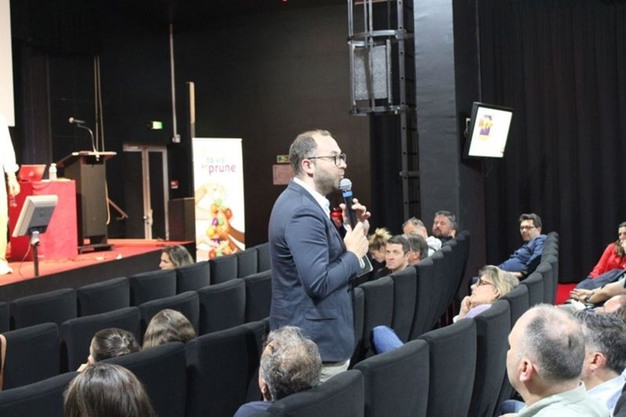
This year's event was also marked by a focus on transmission, with a strong presence of the new generation of producers. When they came to speak, they shared the issues at stake, in particular that of securing an economic activity in which they have invested since the start of their careers. "It is also important to show that the younger generation believes in the future and is committed to it," concludes Raphaël Martinez.