Although growers are stewards of the land, with a responsibility for the environment that sometimes goes unacknowledged, they are also businesspeople who need to have an eye on the bottom line. And one of the big input costs for any farm is fertiliser. These considerations can be balanced, though, according to Zenon Kynigos of ProdOz, who says trials of the fertiliser Lono are pointing to a rare alignment between productivity, environmental protection and farm economics.
In a nutshell, the benefit from Lono comes from using nitrogen in a different form. Ordinarily, the nitrogen from conventional fertiliser largely feeds and stimulates growth of the plant's green parts. Only a small amount can be taken up as amine (NH2), which boosts growth of fruits. But as well as being amine, Lono also proves beneficial because it binds to soil particles and cannot easily be washed away or converted by microbes.
 © ProdOz
One issue little talked about is how much nitrogen in the average load of fertiliser goes to waste or is used by plants in a way that is not economically productive.
"Nitrogen is the biggest nutrient pollutant in water systems," Kynigos says, pointing to impacts near the Great Barrier Reef, Moreton Bay and other coastal farming regions.
"The nitrogen entering the water system stems from the fertiliser. That's the source of the environmental problem."
Traditional nitrogen fertilisers, he says, are inherently inefficient and wasteful because they're not stable in the environment. They are highly reactive in the soil
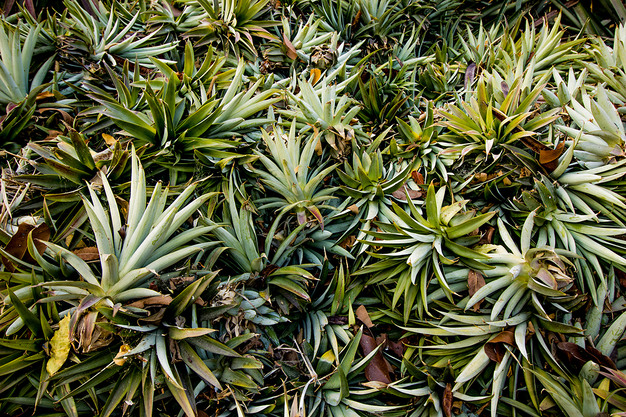
That inefficiency is what led ProdOz to trial Lono in pineapples. "We do a lot of work on the pineapples here in Queensland," Kynigos says. "The growers have been able to halve their standard preplant and foliar applications of nitrogen without losing yield or quality, even improving it."
The contrast is striking. Five litres of Lono contain the equivalent of only about one and a half kilograms of nitrogen. "We've removed 200 and replaced it with one and a half in the pre-plant, and we're getting better results and better retention of nitrogen in the soil."
The efficacy was tested in one of the harshest possible environments. A pilot study with Queensland's Department of Agriculture and Fisheries and Queensland Fruit and Vegetable Growers (formerly Growcom) used extremely sandy pineapple soils in Wamuran, with around one metre of rain during the trial period.
 © Nattarada Nartakong | Dreamstime
"The results were just staggering," Kynigos says. "We had better-growing plants, they were heavier, we had much better root systems, better retention of nitrogen in the soil water."
In commercial terms, that translated directly into better returns. "At the packhouse we're looking for numbers, size, sugar content and quality. All part of the growers' return on investment (ROI)."
He says the results have already driven adoption by major growers including Polsoni Pines, Pace Farming and Sandy Creek Pineapples. For growers, though, the selling point is not environmental virtue.
"If I can say to a grower, you've used less and maintained or improved yield, that's what they want to hear," Kynigos says. The benefit to the environment is the icing on the cake.
That argument has become more urgent as fertiliser prices and supply pressures intensify. "The price of urea is going up, supply is uncertain, and growers are going to have to use less," he says. "So we're trying to get them to use something that's a lot more efficient, so they don't have an impact on their yield."
For Kynigos, that makes the issue bigger than agronomy alone. "It's absolutely a food security issue," he says.
"If growers can't get fertiliser, or they can't afford it, it will have a knock-on effect on yield. What we're trying to do is help them use less, but not lose production. That's where food security starts."
For more information:
Zenon Kynigos
ProdOz
Phone: +61 467 628 493
[email protected]
www.prodoz.com.au