Driven by a rebound at the start of 2026, global air freight momentum was disrupted by the conflict in the Middle East, affecting flows, pricing, and market visibility.
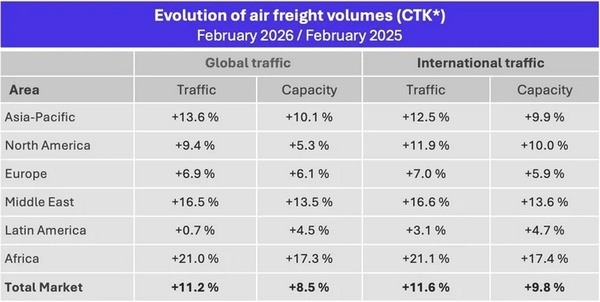
Following a dynamic January, February volumes increased by 11.2% year-on-year, and by 11.6% on international routes, according to the International Air Transport Association (IATA). Available capacity rose by 8.5% to nearly 54 billion tonne-km, with international capacity up 9.8%. Demand growth outpaced supply, pushing the load factor up 1.1 points to 46% and to 51.5% on international routes.
Most trade corridors recorded growth. Asia–North America volumes rose 9.1% year-on-year, Europe–Asia increased by 13.1%, and Europe–North America extended its growth trend with a 5.7% rise. Traffic between the Middle East and Asia increased by 24%, while Europe–Middle East flows grew by 9.3%.
 © IATA
The situation shifted at the end of February. According to WorldACD, traffic dropped in early March as airports closed and airline fleets were grounded. Capacity in the Middle East and South Asia later increased by 31% compared to the first half of March, but remained 33% lower year-on-year. Traffic partially resumed during March but remained below previous levels due to ongoing constraints.
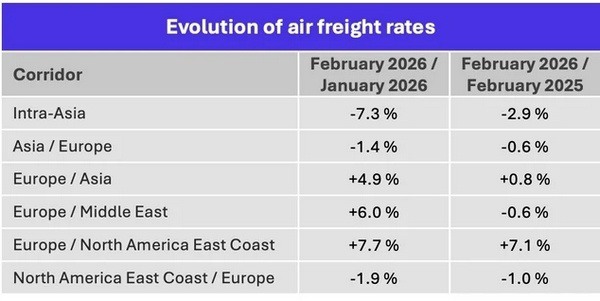
Price trends were already moving upward before the conflict. In February, average unit revenue increased by 6.6% year-on-year, linked to kerosene prices, which reached US$95.7 per barrel. Since the escalation, kerosene prices have more than doubled, with a direct impact on air cargo rates.
Spot rates from the Middle East and South Asia to Europe rose by 5% week-on-week, with a 28% increase from Dubai. Year-on-year, prices increased by 84%, with Dubai rates reaching US$5.44. Rates to the United States rose by 9% weekly and 73% year-on-year, with Dubai at US$10.33. Asia-Pacific to Europe rates increased by 4% week-on-week and 28% year-on-year.
 © IATA
Capacity adjustments, including additional direct flights on Asia–Europe routes, have started to ease pressure. However, further developments depend on fuel availability and pricing, with some operators reporting shortages.
Macroeconomic indicators in February pointed to a supportive environment, with a global manufacturing PMI of 53.1 and export orders at 51.4. However, uncertainty has increased. As stated by Willie Walsh, "The outbreak of war in the Middle East at the end of the month, however, makes it difficult to see how full-year performance will unfold. Sharply rising fuel costs, fuel scarcity in parts of the world, and the severe disruption to key cargo hubs in the Gulf are major shifts".
According to the International Monetary Fund, the conflict is expected to result in higher prices and slower growth, adding pressure on households, businesses, and global supply chains.
Source: Upply