For New Zealand salad leaf producer LeaderBrand, the decision to acquire a laser weeder was not simply a one-dimensional calculation about replacing hand weeding with automation. As General Manager of Farming Gordon McPhail explains, "Some people may be very one-dimensional: Right, I spend a certain amount of money on hand weeding, and this removes that." But for LeaderBrand, "We've had a lot more dimensions to our solution than that."
Those dimensions begin with a broader production challenge. "We're seeing declining yield and inconsistent crops," McPhail says, linking the issue to soil health and rotation pressures in salad leaf production. With spinach and mesclun being central to the firm's revenue, consistency is critical. "When you have a brand in the market, you need consistent quality and supply," he adds.
 © LeaderBrand
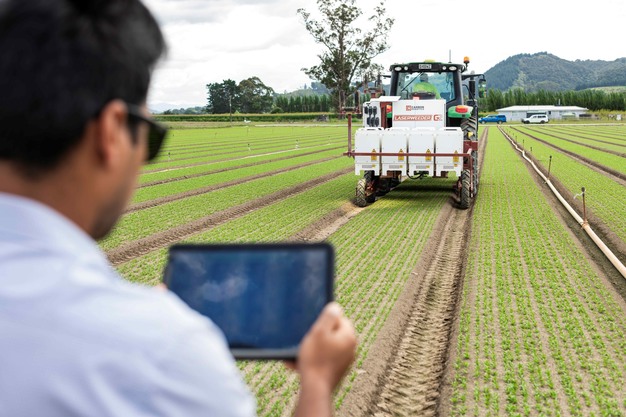
Weeds sit at the centre of that problem, but traditional solutions come with trade-offs. "We have either rotated our soil heavily and weeded everything out, but ended up with poor soil health, or we've used chemicals or a whole lot of people to hand weed," McPhail says. "All of those options are not sustainable." The Carbon Robotics G2 Laser Weeder, he explains, is effectively the only viable alternative. "In our crop… this is the only weed control mechanism."
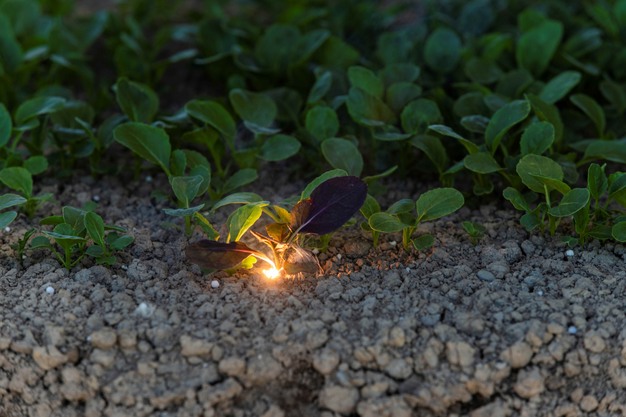
The technology itself is highly precise. The weeder is an American innovation that uses high-resolution cameras, artificial intelligence, and laser technology. It detects and removes weeds right down to the size of a ballpoint pen top, without disturbing the soil or affecting crops.
"It's 99.9% accurate," McPhail says, though in practice LeaderBrand operates "at about 95% accuracy" to balance speed and efficiency. That still leaves a minimal residue of weeds, but crucially changes how labour is deployed. "You're left with just a quick skim across the crop with your people just before harvest. You're not having to pull out many weeds at all," he explains.
 © LeaderBrand
The investment case, however, extends well beyond labour savings. "We've looked at crop quality, we've looked at factory throughput, we've looked at brand recognition, and we've looked at soil health and sustainability," McPhail says. These are longer-term, less easily quantified gains, but central to the decision. "You can look beyond that one-dimensional model because that's how we make this thing stack up."
Support from New Zealand's Ministry for Primary Industries in the form of a grant played a key role in enabling that broader approach. "It's not cheap," McPhail says, "but the grant allowed us test concepts and to explore how to use it properly without overly exposing us to too much risk in for the first 12 months." That exploration phase has been critical. "You don't just turn it on and drive it into the paddock. You have to understand the processes and structures around it to make sure it's effective."
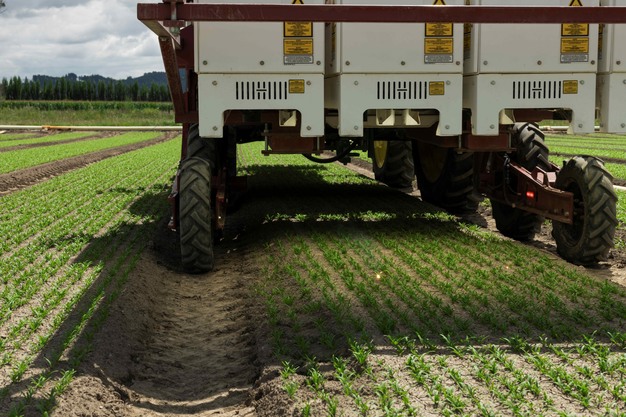 © LeaderBrand
More importantly, the funding has enabled the business to pursue benefits that are difficult to quantify upfront. "Call them intangibles. Those are where the gold nuggets are hidden," McPhail says. "You know they exist; you just can't sell them to the bank." Improvements in soil health, consistency, and brand value may take years to fully materialise, but are central to long-term performance.
"The technology works, it does what it says it does," he concludes. "The question is what your business case looks like, and how it adds value within your system."
For more information:
Katherine Klouwens
LeaderBrand
Tel: +64 21 484 026
[email protected]
www.leaderbrand.co.nz