On March 21, the first white asparagus of this year's season was harvested at the Spargelhof Willemsen farm in Wassenberg. "Earlier than ever before," says Alexander Willemsen, who runs the farm together with his brother André. In addition to meeting the needs of their approximately 30 own asparagus stands in the neighborhood, they have already been able to deliver smaller quantities to retailers. According to the two brothers, regional asparagus will be widely available by Easter.
The early start to the season is attributed to the excellent growing conditions in the summer and fall of 2025. The final phase of growth before the actual start of the harvest was also optimal, "though the cold stimulus could have been a bit more pronounced," says André Willemsen. While the rainfall in week 13 wasn't particularly severe for cultivation, it doesn't exactly encourage people to eat asparagus. "We're definitely feeling that in the marketing of fresh asparagus. All in all, though, we're very satisfied with the start of the season."
In light of the latest minimum wage increase, the price level is the main topic of discussion at the start of the new season. Willemsen: "In direct marketing, we're starting the new season with nearly identical entry-level prices for the third year in a row. We are firmly convinced that we should not unsettle or even deter consumers, especially at the beginning. Furthermore, experience shows that cost increases tend to even out as the season progresses." In addition to labor costs, which have the greatest impact, rising fertilizer prices also represent a secondary cost driver.
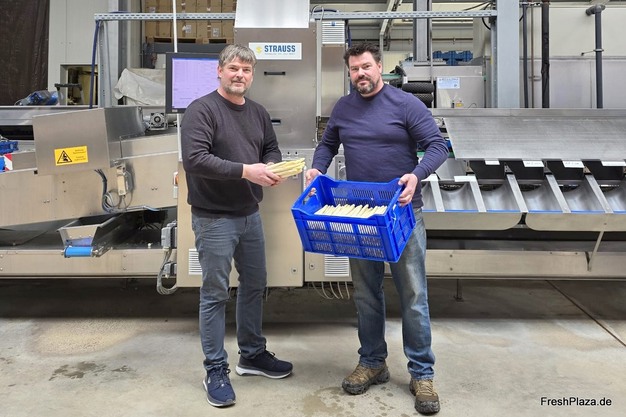 © Hugo Huijbers | FreshPlaza.comAlexander and André Willemsen show off the first early asparagus of the Prius variety.
Gradual advancement of the season
On numerous plots in the German-Dutch border region, the Willemsen family cultivates a total of around 150 hectares of asparagus. As a second source of income, young asparagus plants are produced on approximately 35 hectares, according to André Willemsen. "We used to start delivering our young plants around mid-March, but as the season has gradually shifted earlier, the start of harvesting has tended to move up so that we now begin as early as the first week of March." Much like with fresh asparagus, the outlook for young plant propagation is clearly positive. "We're expecting a good yield this year."
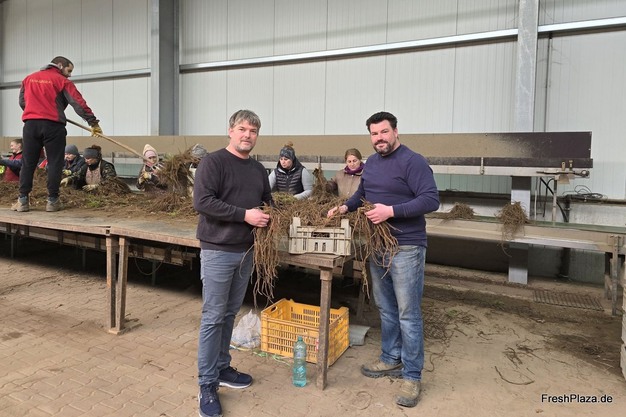 © Hugo Huijbers | FreshPlaza.comCost increases are also unavoidable in seedling production. Seeds, in particular, are becoming slightly more expensive every year.
In contrast to the distribution of fresh asparagus, where regionality is the top priority, the young plant sector has developed into an international business over the years. "We supply asparagus farms throughout the DACH region, Benelux, France, Hungary, Romania, and Poland. This year, we even received an inquiry from Georgia for the first time. Due to the distance and the costly, complex logistics involved, we'll have to evaluate whether it will be profitable for us to fulfill such requests in the future." Although the majority of sales volume consists of white asparagus, the green variety is also continuing to gain slightly in importance.
The market for asparagus plants is solid but also particularly competitive, Willemsen continues. "Unlike our competitors, we don't have sales representatives abroad. But what still sets us apart is that we draw on our own experience in asparagus cultivation and can thus provide careful advice to each customer." The latest statistics point once again to a downward trend in asparagus cultivation, particularly in Germany. "The years of major growth are behind us. Nevertheless, we've noticed that most of our customers want to maintain their current acreage. This is also necessary if we aim to continue supplying the market with domestic asparagus across the board in the near future. We mustn't forget that there has been an asparagus shortage in the middle of the season in each of the past two years."
Wide range of varieties and customers
About 15 percent of the total acreage in Germany needs to be replanted annually with new planting stock, the asparagus merchant further estimates. He provides advice and support to both large-scale mechanized operations and medium-sized farms with just a few hectares. The product range now includes up to 25 different varieties. "Although the early part of the season continues to carry significant weight, the late season has also been regaining relevance in recent years. Consequently, growers have introduced several good varieties such as Mosalim, Sirius, and Raffaelo to the market in recent years, ensuring that the market remains well-stocked even in May and June," he concludes.
For more information:
Alexander & André Willemsen
Zegra Spargelwelt GmbH & Co. KG
Ossenbrucher Weg 10
41849 Wassenberg
Tel.: +49 (0) 24 32 89 27 34
[email protected]
www.zegra.de