Hybrid potato seed could eventually become an alternative to seed potatoes. In trials with True Potato Seed (TPS), yields ranged from 26 to 50 tons per hectare, depending on the cultivation method and starting material. PhD research by Luuk van Dijk at Wageningen University & Research (WUR) shows which cultivation choices and preconditions are decisive. 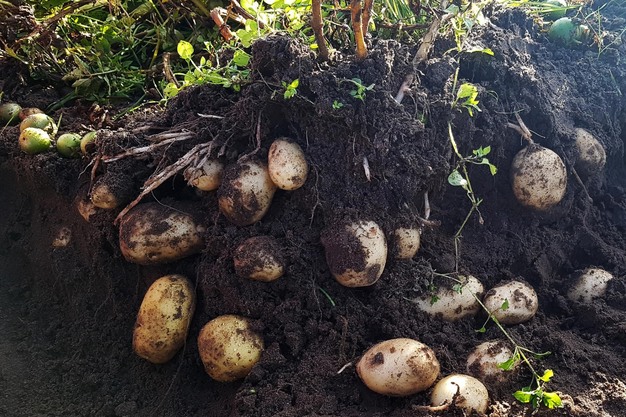 © WUR
© WUR
Potatoes grown from hybrid potato seeds sown directly in the field (Photo: Luuk van Dijk, WUR)
In north-western Europe, potatoes are currently grown from seed potatoes: tubers propagated vegetatively. This system has a low propagation factor, requiring several field seasons to build up sufficient starting material. It also increases the risk of soil-borne diseases in seed potatoes, among other issues. In addition, seed potatoes are bulky and perishable, placing demands on storage, transport, and logistics. In contrast, TPS is small, non-perishable, and has a much higher propagation factor. It also offers disease-free starting material.
Seedlings from the greenhouse: Steering on timing and density
In field trials with greenhouse-grown seedlings, Van Dijk investigated, among other factors, the effect of ridging, the practice of raising soil around the base of the plant to stimulate growth and root development. This did not affect total yield in kilos, but it did influence tuber number: more tubers were harvested in ridged plots than in non-ridged plots. Yields from these trials reached 26 and 32 tons per hectare, bringing them close to average seed potato yields. The findings were published in a study that reported such high yields for potatoes grown from seed for the first time.
Planting time also proved important. Early transplanting in March was associated with a risk of yield losses due to cold and frost, while late transplanting in June resulted in lower yields due to a shorter growing period compared to transplanting in April or May. Seedling age made no difference: 6-week-old seedlings performed just as well as younger 4-week-old seedlings, supporting the observation that larger plants experience greater transplant shock after planting.
Multi-year trials also show that plant density is an important practical control factor for both yield and size grading. In a bed system on light sandy soil, yields of 107 tons per hectare were achieved at 200 plants per square metre. Yield in the commercial size grading of seed potatoes and small potatoes reached a maximum of 64 tons per hectare at a density of 50 plants per square metre.
Direct sowing: Fewer steps, focus on emergence
In addition to transplanting, Van Dijk investigated direct field sowing with coated TPS. A proof of concept showed that some trials yielded 50 tons per hectare or more. This approach removes part of the propagation, planning, transport, and transplanting process. It also eliminates the delicate and more costly step from greenhouse to field. At the same time, field sowing places higher demands on the initial phase of cultivation. For example, sufficient moisture is crucial for good emergence.
The thesis makes it clear that widespread adoption of TPS depends not only on the cultivation method but also on the variety. Practical acceptance requires hybrid varieties with characteristics such as good tuber size uniformity and improved disease resistance. Because experimental hybrids were used in this study, further improvements are expected. According to the thesis, the combination of improved genetics and TPS cultivation systems could be particularly impactful outside north-western Europe. In sub-Saharan Africa in particular, the potential is considered high.
Luuk van Dijk's PhD will take place on 23 March at Wageningen University & Research.
Source: WUR