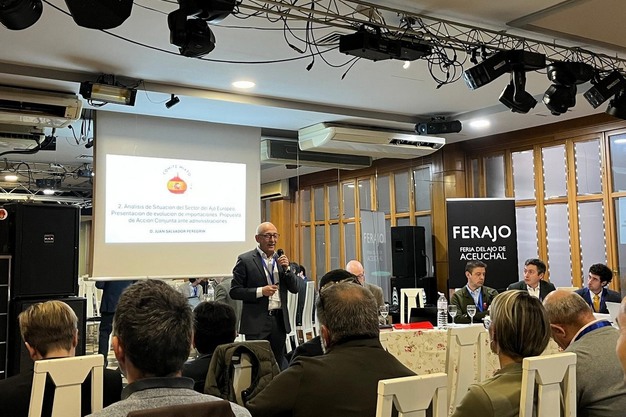
Over the past two days, more than 50 representatives from the garlic production and marketing sectors in France, Italy, and Spain participated in the Joint Committee's Garlic Contact Group meeting in Aceuchal. The gathering focused on examining the challenging situation of the crop across Europe and establishing targeted proposals to ensure its sustainability.
During the meeting, it was evident that the primary threats to the European sector's viability stem from a steep rise in production costs. Recently, growers have dealt with price increases exceeding 40% for phytosanitary products, fuel, fertilisers, and other crucial inputs. This trend is closely related to regulatory impacts and the global economic situation.
 © FEPEX
This situation is compounded by a significant rise in garlic imports over the past three years, primarily from China and Egypt. Sector representatives concur that this is no longer a future threat but a genuine risk to the survival of the European garlic crop.
In response to this situation, the Contact Group decided to inform MEPs of the urgent need to take measures, such as activating the safeguard clause against imports from Egypt and China.
It has also recommended updating the deterrent tariff of 1,200 euros per ton for Chinese garlic imports, which has been in place since 2001. The sector believes that the failure to revise this measure has gradually diminished its effectiveness due to the loss of value caused by inflation over more than twenty years.
The committee has also suggested implementing additional measures, such as strengthening customs surveillance, improving control systems, ensuring traceability, and verifying the origins of the product to prevent triangular imports. It also recommends establishing strict border controls to guarantee that imported garlic complies with the same food safety standards required of European production.
Regarding production, the representatives emphasized the importance of enhancing the availability of active materials approved in the European Union. This aims to restore per-hectare yields to previous levels, which have declined following the removal of many phytosanitary tools.
The National Association of Garlic Producers and Marketers (ANPCA) has warned that the current situation is endangering not only farm profitability but also the stability of the industry and related business network. The organization has highlighted that European garlic faces clearly unequal conditions compared to imports from third countries, which are not subject to the same regulatory standards or costs.
ANPCA has emphasized the urgent need for European institutions to act swiftly and decisively to prevent an irreversible loss of cultivated land and production capacity, highlighting that garlic cultivation is crucial for sustaining employment, economic activity, and regional cohesion in many rural communities.
The sector agreed that implementing effective measures in the short and medium term is crucial to maintain the competitiveness, sustainability, and future of one of the most iconic horticultural crops in European production.
The Fepex delegation in the garlic contact group consisted of producers and marketers affiliated with ANPCA, led by its president, Juan Salvador Peregrín, along with the general manager, Luis Fernando Rubio, and the Federation's technical director, Luis Martín.
For more information:
www.fepex.es