Azienda Agricola Octavius boasts over 60 years of history in the agricultural sector, with a generational transition completed in 2019 under the leadership of Luigi De Giorgio. The operational centre is in Nardò, in the province of Lecce.
"Our production covers the entire year. From May to September, we are busy with watermelons in Salento. From October to March, we produce citrus fruits in the Taranto area, particularly in Palagiano and Massafra," explains Luigi De Giorgio. As far as watermelons are concerned, De Giorgio explains that they "Also have covered structures, i.e., greenhouses and tunnels," but points out that this type of cultivation is only "a small part compared to the open fields."
 © Agricola Octavius
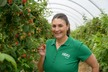
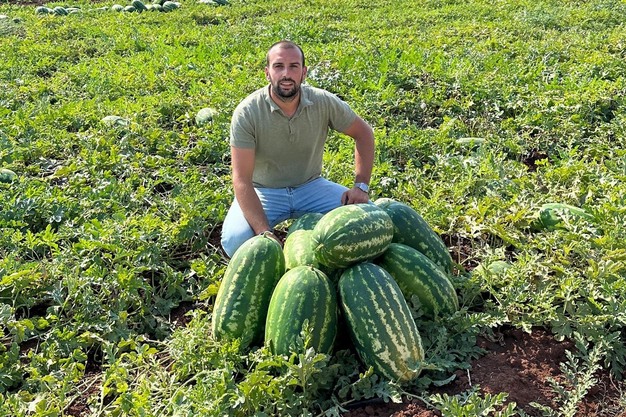
Luigi De Giorgio at the last watermelon harvest
The company manages around 200 hectares of land distributed mainly in the Salento area (Nardò, Lecce, Brindisi, Bari). It permanently employs 50 people and operates according to high-quality and sustainability standards, being GlobalGAP, Grasp, and Spring certified. It is also part of a producer organisation in Polignano, which is strongly export-oriented.
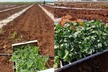
Octavius is currently in the process of transplanting watermelons. "The month of February was characterised by incessant rainfall, which prevented the land from being prepared, resulting in a delay of about 10 days. We are transplanting classic watermelons, mini watermelons, and long Dumara ones. To make up for the delay, we have doubled our operational resources by increasing the number of daily tractors working from 3 to 6, and doubling the number of workers in the field from 15 to 30. We still have one more week of heavy work to do, and then we will be back on schedule. We are using seedlings supplied by specialised Sicilian nurseries, already prepared and trimmed. The aim is to finish the transplanting phase to ensure the start of the first harvesting operations in the open field around early June."
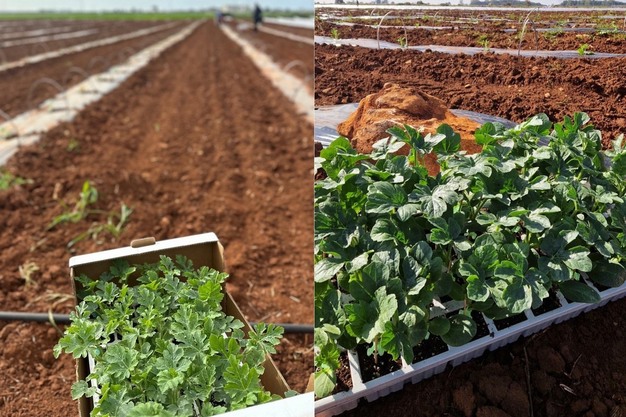 © Agricola OctaviusTransplant phase
The Octavius business model is based on supply chain contracts with large exporters and packers. "The product reaches key markets such as Germany, the Netherlands, Switzerland, France, and Poland. Our production also supplies international distribution chains. Mini watermelons are mainly destined to supermarkets, while the Dumara variety serves both the big retail trade (GDO) and local wholesale markets. Demand is closely related to temperatures in Europe." De Giorgio compares watermelon to ice cream: "You can eat it in winter, but you enjoy it much more in the heat of summer."
Speaking of international competition, the main competitors are Greece, Spain, and Turkey. "In particular, Greece and Spain are able to intervene aggressively in the market, especially in contexts of overproduction, thereby altering the price balance. Turkey, on the other hand, maintains a stable presence thanks to well-established multi-year contracts with the German big retail trade."
The company owner also emphasises how the agricultural sector is suffering from a margin squeeze due to several factors. "First and foremost, there are the generalised price increases. This translates into higher costs for fuel, electricity, contributions, and certification fees. Then there is an asymmetry of power. Producers are the initial link in the chain, often forced to endure the prices imposed by the supply chain. And unforeseen costs - such as the diesel currently at EUR 2 due to the ongoing tensions in the Middle East - weigh exclusively on producers, making economic sustainability difficult for those who do not directly manage the entire production phase." The company's vision is oriented towards a fair supply chain philosophy, where the producer's right to a decent income is protected, while ensuring sustainability and quality standards for end consumers.
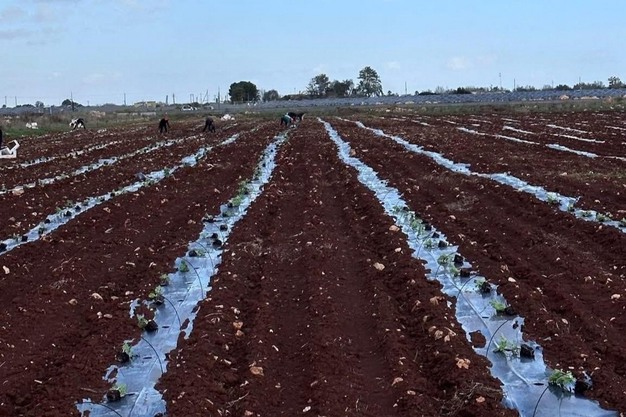 © Agricola Octavius
Transplantation phase
Finally, De Giorgio emphasises the importance of generational change, lamenting how young people are often excluded or not put in a position to operate by the sector's 'dinosaurs'. "Luckily, this is not my case. I did not have this problem because my grandfather taught me early on to get into the field and not to worry, because I would have my slice of bread. But some young people do not have this privilege, and sometimes they are not given what they are entitled to. They say appetite comes with eating, but you also have to make young people eat."
The success of the watermelon season remains ultimately dependent on the stability of the climate and the resilience of the global economy. "I am always very optimistic - you have to be in this business. If the weather at the European level helps us, then there will be no problems," concludes De Giorgio.
For more information: Agricola Octavius
Via Avetrana SN
73048 Nardò (Lecce) - Italy
+39 329 3313885
[email protected]
agricolaoctavius.com