For many years, Früchte Widmann has focused not only on marketing but also specifically on its own berry cultivation. After starting its own production in Romania in 2007, further cultivation projects were continuously established – today, the southern German company is active on a total of three continents. Früchte Widmann acquired a stake in the Chilean blueberry producer Valle Maule SA back in 2016. With the current campaign, its own cultivation in Chile is already in its tenth season.
Valle Maule brings together selected main producers and several long-standing contract growers to form a well-coordinated producer group. The cultivation areas are spread across various regions in central and south-central Chile. The main cultivation region and company headquarters are in the Maule region, around 150 kilometers south of Santiago de Chile. The targeted establishment of plantations in different climate zones in Chile means that the harvest season can be significantly extended. "This means that fresh blueberries from Chile are available continuously from January to March. Only selected blueberry varieties are cultivated on a total of around 300 hectares. In addition to the cultivation itself, plant protection, certifications, and marketing, including exports to Germany, are also centrally controlled – all from a single source," according to Widmann GmbH.
Maximum transparency along the entire supply chain
Over 5,000 tons are planned for the 2026 season – an amount that corresponds to three times the annual per capita consumption of the city of Berlin. "We are proud of our own blueberries, which we bring to our customers from Chile every year from January to March. In addition to the excellent fruit quality, maximum transparency along the entire supply chain is a real added value," explains Dr. Hans Widmann, managing partner of Früchte Widmann. The supply and demand for blueberries on the German and European markets are currently rated as good.
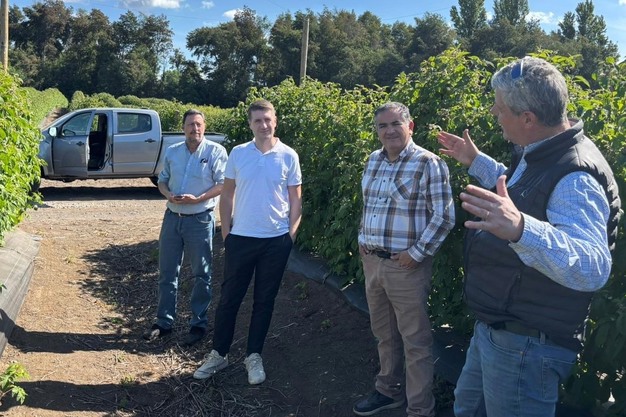 © Herbert Widmann GmbHTo ensure these high-quality standards, the Widmann team visits Chile every year to personally inspect the cultivation, harvest, and quality of the blueberries. Pictured: Managing Director André Kirchenwitz (2nd from left) visiting Chile.
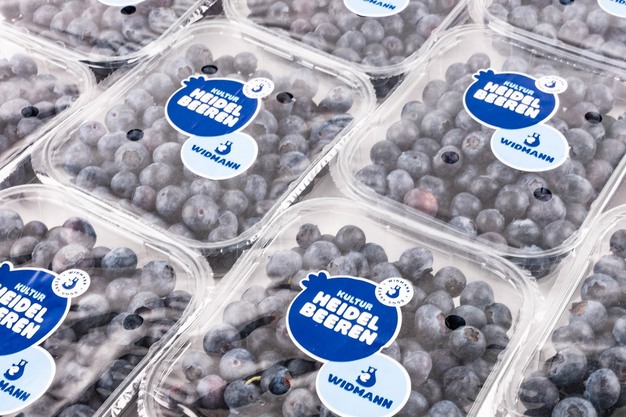
After harvesting and initial sorting, the blueberries are shipped to Europe. Früchte Widmann can monitor the ship's position and arrival times at any time and precisely coordinate quantity planning accordingly. Upon arrival at the port of Rotterdam, the goods are transported directly to the service center of Nordgemüse, a subsidiary of Früchte Widmann near Hanover. There, the final sorting takes place on state-of-the-art equipment. The blueberries are then packed in trays, sealed with a top seal, and labeled – all done daily, shortly before delivery to customers.
 © Herbert Widmann GmbH
Packaged blueberries for the German food retail trade
Northern German location as an ideal hub for overseas blueberries
"Especially in sensitive seasonal phases, packaging in Germany offers a decisive quality advantage over goods already packaged overseas. At peak times, Nordgemüse processes up to 100 tons of blueberries daily – from sorting and packing to delivery to customers throughout Germany. Thanks to short transport routes, Früchte Widmann's customers are also usually supplied directly by Nordgemüse," explains Widmann.
"Thanks to its central location in Buchholz (Aller), the distances from both the port and our customers are particularly short. The Nordgemüse service center is therefore the ideal hub for our blueberries from overseas," explains André Kirchenwitz, managing director of Früchte Widmann.
 © Herbert Widmann GmbH
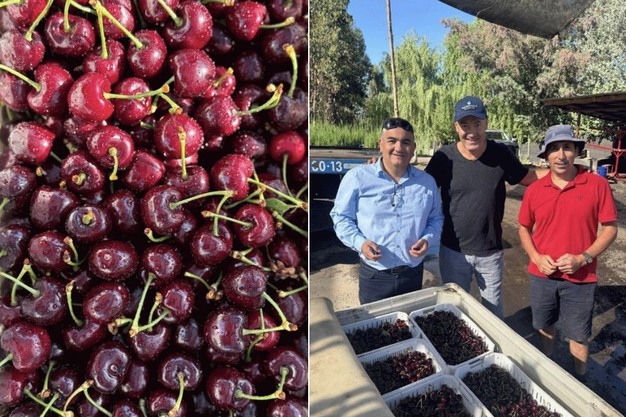
Left: Freshly harvested sweet cherries from Chilean cultivation. Right: Dr. Hans Widmann (center) visited the place of origin at the start of the harvest in mid-December.
Increase in volume expected for Chilean cherries
In addition to blueberries, they currently also market cherries from selected partner producers in Chile. A total of around 150 hectares of cultivation area is available for this purpose. The proven varieties Santina, Lapins, and Regina are grown, which are characterized by good fruit size, firm consistency, and excellent taste. "The majority of the cherry orchards consist of young trees, so harvest volumes are expected to continue to increase in the coming years," explains André Kirchenwitz.
The marketing of Chilean cherries begins annually in December and continues until February, making them an ideal addition to the winter fruit range. "Cherries are even less established during the off-season and are therefore less in the consumer's focus. We have stable delivery programs here, but can supply even more customers in the future," he concludes.
Visit the company at the Gemüsering stand at Fruit Logistica: Hall 20 | B-41

For more information:
Dr. Hans Widmann
Herbert Widmann GmbH
Karwendelstraße 9
82024 Taufkirchen
Phone: +49 89 76 44 18
e-mail: [email protected]
www.widmann-fruechte.de