One year is not the other at the celeriac market. "Last year the tubers were expensive from the abandonment period onwards. The price remained continuously at a high level and then a lot of tubers went away. As the tubers didn't really get more expensive, growers and traders could incidentally make little profit on them, as they would have been better off selling from the field afterwards, but you never know in advance," observes Robert den Ouden of Rodeno Agri Products.
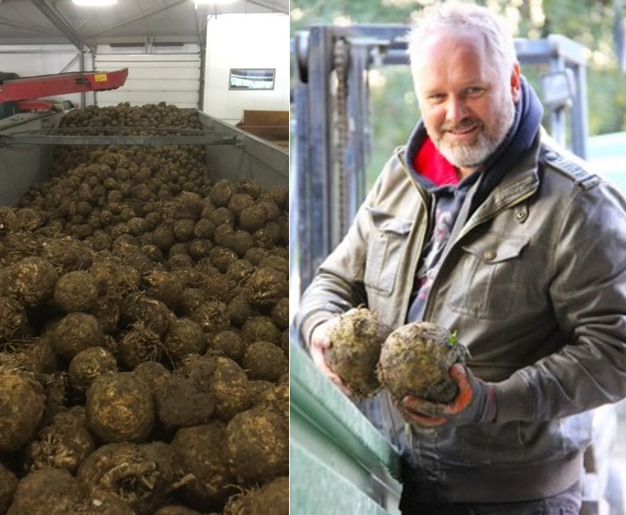
"This is how we rolled into the new season when the old celeriacs were not quite finished. That got in the way of the new celeriac. The price level still started at a similar level as the old tubers, but then collapsed considerably. The first harvests still sold for 40 cents, but the price level quickly dropped to 30 and 20 cents. Then the price hovered around 9 cents for a long time and currently even less is paid at the farmer," Robert says.
Aftergrowth
"When you know that at a yield of 50 tonnes per hectare, you need 20 cents per kilo to cover the costs, the loss is chopping away at the farmer quite a bit," the trader continues. "The expansion, not only in the Netherlands, but also in a country like Poland, has hit quite hard. In recent years, returns on the celeriac market have been good and that has resulted in this expansion of the acreage. Moreover, yields have been good everywhere. The quality was already good after a dry summer and the high temperatures in the autumn meant there was also good aftergrowth."
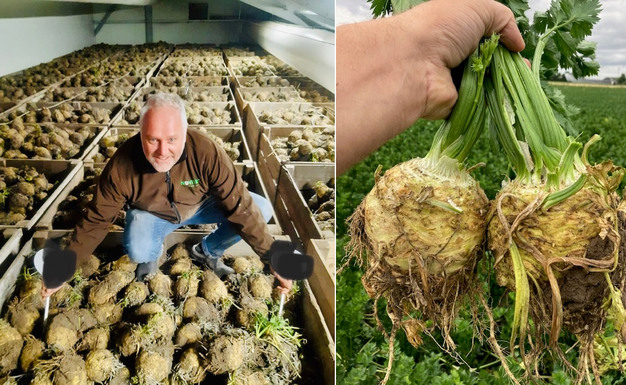
"We haven't had a frost or flood this year and it just goes to show that no disaster is the biggest disaster for the market. All in all, the expansion has just been too big. This has left the new celeriac growers with the lid on their noses, but traditional celeriac growers also have to pay the price. I therefore expect a big contraction for the next season, because it is quite a risk to go into an expensive crop like celeriac, but there are not too many alternatives. There are not many outdoor vegetables that have been expensive this year though."
"Luckily a lot of tubers are sold, we have also had a year where the tubers could not be given away, then you have an even bigger problem. Eastern Europe, as usual, is taking the lead on the tuber market. I just hope the demand stays on and picks up even more, then we'll see where we are in a few months," says Robert.
Rodeno Agri product is a specialist in supplying industrial celeriac for frozen or canning factories in countries such as Belgium, France, Germany Poland and Italy. This expertise also includes supplying cutting plants and various packers for the fresh market. "For the industry, the campaign will be restarted early next year. For this, many contracts have been concluded in Belgium. Now the yields there were not too bad initially, but there too additional tonnes will come off a hectare due to aftergrowth."
 For more information:
Robert den Ouden
Rodeno Agri Products BV
PO Box 110 4460AC Goes
T: +31(0)6 531 90 100
www.rodeno.nl