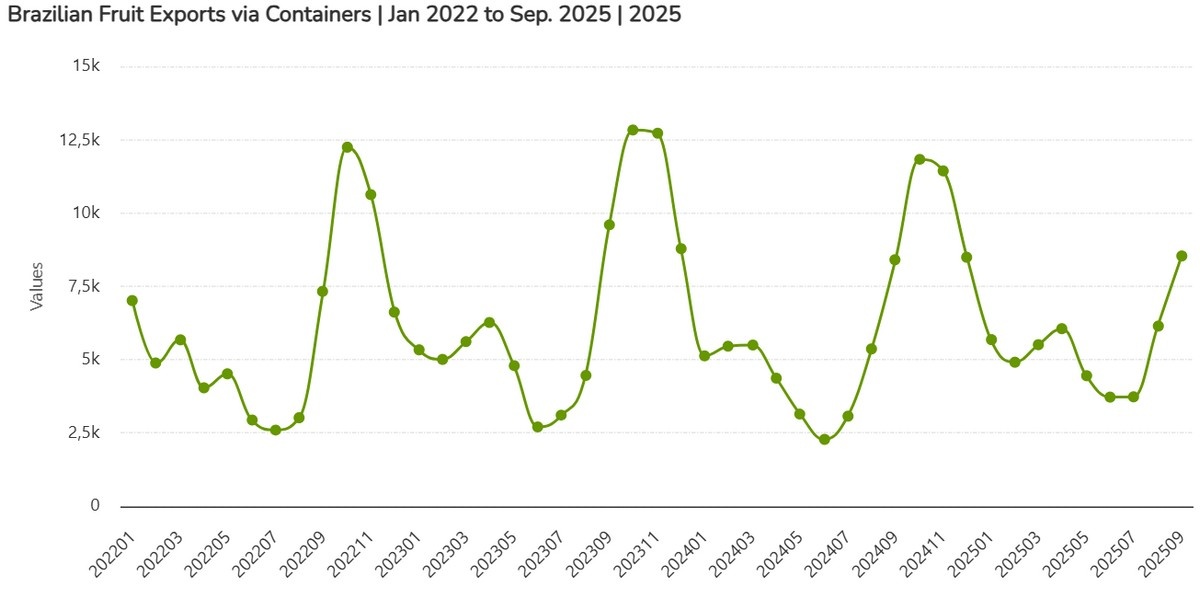
Brazilian fruit exports reached their highest October revenue in ten years, generating US$177.5 million in 2025, up 4.60 per cent from US$169.7 million in the same month last year, according to Comex Stat data from the Ministry of Development, Industry, Trade, and Services. Only November 2024 exceeded this figure, with US$217 million in revenue from fresh or dried fruits and nuts.
Export volume in October reached 209,400 tons, equal to 2.61 per cent of agribusiness exports. From January to October 2025, Brazil exported 1 million tons of fruit, matching the total exported in all of last year. Export revenue for the first ten months of 2025 amounted to US$1 billion, compared to US$1.2 billion recorded in 2024. Fruits represented 1.66 per cent of agribusiness exports last year, ranking fifth in the sector.
"Even with all the crises faced this year by fruit growers, the momentum in exports was maintained, showing that Brazilian agriculture is resilient and prepared to face the challenges of the market and also of the climate. Fruit production is one of the pillars of national agribusiness, both from the internal perspective and in exports, contributing significantly to agribusiness GDP," said Ascenza Brasil director Renato Francischelli.
Four northeastern states generated 84.30 per cent of Brazil's fruit export revenue in October. Pernambuco led with US$56.1 million (31.60 per cent), followed by Bahia with US$38.6 million (21.80 per cent), Rio Grande do Norte with US$36.1 million (20.30 per cent), and Ceará with US$18.8 million (10.60 per cent).
Europe remained the main export destination at 66.40 per cent of revenue. The Netherlands purchased US$71.7 million in Brazilian fruits, equal to 40.40 per cent of total October exports. The United Kingdom followed with US$31.2 million (17.60 per cent), then Spain with US$14.9 million (8.40 per cent). The United States imported US$15.5 million (8.70 per cent), supported by a tariff reduction on fruits from 50 per cent to 40 per cent. In South America, Argentina was the main buyer at US$8.5 million (4.80 per cent).
He added that export markets require adherence to production and traceability standards, high-quality fruit, and compliance with phytosanitary rules such as residue limits. Francischelli suggested that growers collaborate to reduce logistics costs for perishable crops. He also highlighted the need for post-harvest quality management, noting that "fruits destined for export need to maintain quality, freshness and appearance even after harvest, during transport and storage."
For crop protection, Francischelli said producers should adopt continuous monitoring and appropriate pest management to meet export requirements. He also noted that soil quality, nutrition, and irrigation must be part of production planning and that farmers must maintain records of pesticide applications and follow residue limits required by destination markets.
Source: Sociedade Nacional de Agricultura / DatamarNews