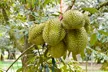
Consumers of passion fruit get more than just a tasty drink or snack. It's packed with nutrients like vitamin C, fiber, and antioxidants, making it a popular choice for healthier eating. It's also important to farmers in tropical and subtropical regions, including central, Southeast, and Southwest Florida.
Understanding how varieties of passion fruit stay fresh after they're harvested can help reduce waste, improve nutrition, and make sure consumers enjoy the fruit and its health benefits, said Tie Liu, an associate professor of horticultural sciences at the University of Florida Institute of Food and Agricultural Sciences (UF/IFAS).
Liu led a newly published study in which he and his colleagues wanted to find out why some varieties of passion fruit stay fresh longer than others.
 © UF/IAS
L: Ellen Garcia; R: purple passion fruit
n the study, scientists examined three kinds of passion fruit and used special lab processes – called metabolomics -- to measure natural chemicals like sugars, acids, and flavors inside their juice.
"These tools help us see what's in the fruit on a tiny scale by measuring hundreds of different natural chemicals that affect how the fruit tastes, smells, its nutrition level, and how long it stays fresh," Liu said.
One variety, called Passiflora ligularis – or orange passion fruit -- stayed fresh the longest. It also had low acidity, more vitamin C and flavonoids, all of which help protect the fruit from spoiling.
While orange passion fruit grows mainly in South America, purple passion fruit -- also known as Passiflora edulis -- grows widely in Florida. It contains more fruity esters, which make it more flavorful.
 © UF/IFAS
The study showed that one variety, called Passiflora ligularis – or orange passion fruit -- stayed fresh the longest.
Now that scientists have identified genetic and biochemical markers associated with passion fruit deterioration, researchers can help breeders select firmer varieties that better resist shriveling, Liu said.
Specifically, by collaborating with Ali Sarkhosh -- a passion fruit researcher with UF/IFAS and a co-author of the paper -- and by incorporating metabolomics insights, plant breeders can develop new, healthier passion fruit varieties that taste better and stay fresher longer after harvest.
Liu received significant help on the study from Yu Wang, an associate professor of food science and human nutrition at the UF/IFAS Citrus Research and Education Center in Lake Alfred. Wang studied the chemical profiles of the passion fruit varieties. Her lab focused on identifying and quantifying the metabolites to help characterize taste.
Liu emphasized that doctoral student Ellen Garcia contributed significantly to this project, and the study was a collaboration between UF/IFAS and the Universidade Federal do Ceará in Brazil. That's because the study's co-first author, Raquel Miranda, worked as a visiting professor at UF/IFAS while she remains on the faculty at the university in Brazil.
 For more information:
Brad Buck
UF/IFAS
Tel: +1 (656) 347-8422
[email protected]
www.ifas.ufl.edu