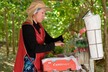
Orchardist Lee Mi-suk remarked, "What good is inspecting the pollen when there are no ovaries?" as she dusted pollen on pear blossoms in Sabolguk-myeon, Sangju, North Gyeongsang. The pistils of the flowers had turned black due to unseasonal spring cold, causing frostbite-like damage.
Lee noted, "In over 30 years of growing pears, I've never seen the blossoms freeze and die off like this." Sabolguk-myeon, a key pear-growing area, saw temperatures drop to minus 5.2 degrees Celsius on March 30, killing the pistils and halting fruit production. Local estimates indicate that over 90 percent of farms were affected, with another cold snap on April 13 further damaging blossoms.
Park Jong-uk, head of the Sabolguk-myeon community, stated, "Normally, we sell about 50 billion won [$35 million] worth of pears annually, but this year, we'll be lucky to make even 5 billion won." Erratic weather, including a warm spell in mid-March, caused early blooming, followed by a sharp temperature drop that killed the pistils. Wind machines used by farmers had little effect.
Lee Sung-dae, head of the pear exporters' association at the Sabolguk branch of the National Agricultural Cooperative Federation, reported, "Some farms are reporting sterility in up to 99 percent of their blossoms. Young farmers who moved here and borrowed money to grow pears are in total despair."
Other crops, such as peaches and apples, also suffered from erratic weather. In North Chungcheong, 545 cases of cold damage were reported by April 14, with peaches accounting for 210 cases. Apple production is threatened by cold damage and recent wildfires in North Gyeongsang.
Climate experts attribute spring weather anomalies to global warming, causing early blooming and increased vulnerability to cold snaps. Jeong Su-jong, a professor at Seoul National University, stated, "In the past, we believed that warmer weather and earlier flowering would boost crop productivity. But what we're seeing is the opposite — more frequent spring frost damage and worsening productivity."
Farmers are urging research and countermeasures for climate-related disasters. Some countries have implemented index-based climate insurance, but in Korea, only half of the farmers enroll in crop disaster insurance, which partially covers frost damage. Jeong emphasized the need for climate-adaptation policies to minimize damages and curb inflation.
Source: Korea JoongAng Daily