On Friday 25 August, Carrefour, New Green and BelOrta presented the first residue free pear in Belgium, according to the cooperatives during a press conference in Heers, Belgium. The participating parties showed how the residue free pears grow on the land of grower Jos Derwael. The pears will soon be available from supermarket chain Carrefour in Belgium.
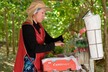
Left to right: Gaston Derwael (New Green), Johan Gerits (BelOrta), Koen Vanoirbeek (Bel'Export), Miguel Demaeght (BelOrta), Wendy Bangels (New Green) en Baptiste van Outryve (Carrefour).
Residue free pear
The residue free pear will be available at Carrefour from September. This will also be the only pear offered by the supermarket chain until early 2018. “When growing residue free pears we respect the customer, the product and the producer,” says Baptiste van Outryve, spokesperson of Carrefour. “Because they have to work differently, the growers also have to invest differently. That’s why we give a fair price for the pears to the growers.”
A residue free pear on a tree.
One of the investments needed to ensure the pears are free from residues, is using animals to combat other animals. “Sixty per cent of insects in cultivation are useful,” says Gaston Derwael from New Green. “These insects ensure that harmful insects cannot damage the cultivation. When plant lice are discovered in the trees, black bags with earwigs, for example, are placed in the treetops. The plant lice will then disappear after a few days.”
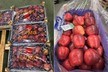
The residue free pears
Game of kestrel and mouse
One of the ways to ensure no or very little pesticides have to be used, is by using natural enemies of harmful animals. Besides the earwig used to exterminate the plant lice, other animals are also used to protect the crops. “Tall posts are placed among the pear trees, on which we breed kestrels,” Gaston says. “These kestrels then catch mice, which are exterminated in that way. We mislead the codling moth by hanging a red thread with the smell of the female codling moth in the trees. This attracts many male moths, but no females, so that they can’t procreate. The codling moth isn’t harmful to the crop, but the young are. This way, we ensure the pears are residue free.”
Kestrels are bred in the little houses on top of the posts, so that they can catch mice.
The red thread on the branch ensures that only male moths are attracted to the pear trees.
Sustainability
Although growing residue free pears sounds different from growing conventional pears, the appearance of the fruit is the same. Yet according to a spokesperson of Carrefour they treat the new pears differently. “We don’t select the good-looking pears and throw the rest away,” Baptiste says. “We offer both large and small pears to the shop. Small pears are placed in bags and are meant for children. Even the slightly uglier pears aren’t thrown away; after all, consumers buy with their eyes. These pears are processed into juice, which we then sell in the shop.”
Whether kestrels ensure the optimum condition of the pear cultivation or whether pesticides are used, the weather continues to have a major effect on the type of fruit. Although the weather remains an unpredictable factor, Baptiste van Outryve isn’t afraid of the consequences of it. “When the weather is bad, the weather is bad,” he says. “You can’t control the weather. We mainly presell the pears, and we try to process the fruit affected by the weather into juice as much as possible. When the weather is bad, we sell more juice and fewer pears. That is therefore not a problem.”
Gaston Derwael (New Green) and Baptiste van Outryve (Carrefour) talking.
Organic but different
Organic or residue free pears, they both sound sustainable, but what exactly is the difference between the two? “That would be the details of the regulations,” says Miguel Demaeght from BelOrta. Pear grower Jos Derwael confirms that. “For me, growing residue free pears is a challenge with added values, but it’s different from growing organically,” he says. “I did consider switching to growing organically once, but this feels better to me. When growing organically, heavy metals such as copper and sulphur can be used, and I can’t use these.”
According to the grower, the organic sector also has more loss. “Because the number of means allowed in the organic sector is more limited, there’s more loss,” Jos continues. “Just as with organic products, we use pesticides, but to a lesser extent. We apply these at the start of the cultivation, but the means are no longer detectable near the end, because we use a measured amount. Because there’s also a limit to that, it means the pears can only be sold from September to early 2018. After that, the chance of moulds becomes larger, and growing the pears becomes more difficult. That’s why the residue free pears will be replaced by conventional ones in supermarkets at a certain point.”
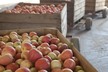
The residue free pears for Carrefour are packed near the growing area before being sent to supermarkets.
Electric cars
Although the final result of the organic and residue free pears is the same, the growing process isn’t, according to Gaston. But why is this manner of growing only applied now? “You could also ask: why are we only now driving in electric cars, and not 30 years ago?” he says. “It’s because of research and development. The same is true for the cultivation. Right now, 50 of the 350 hectares of pears is of residue free origin. Today is the first day we are driving in electric cars with the residue free pear cultivation in our sector. We hope to also introduce residue-free apples soon. We are now working on an apple with very few residues. The growing process of apples cannot be compared to that of pears. It would be like comparing apples and oranges,” Gaston jokes.