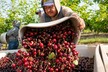
Edeka supplied selected supermarkets with environmentally friendly grown oranges, exactly in time for the start of the new citrus season. And an extra special feature is that the pollution by crop protection products per hectare was reduced by two thirds compared to the previous year. Certain crop protection products are completely excluded and as a result, Edeka is a pioneer in the supply of conventional oranges for the German retail sector.
Easy does it: ladybugs against pests
In the battle against pests, the Spanish Finca increasingly uses gentle methods. The use of chemicals has already been decreased by 90%. “The lack of chemical protection could cause little flaws on the peel. This is purely visual, the quality of the fruit remains flawless,” explains Silja Marschke, project manager of the WWF. Instead of chemicals, beneficial organisms are used, such as ladybugs, the natural enemies of aphids. In addition, the number of ladybird species native to the region on the Finca Iberesparragal has risen from seven to twelve. To promote biodiversity hedges, natural corridors and herbs are planted and nesting sites are created, which caused many other animal and plant species to find their habitat at the farm.
Water for the region
The water used to irrigate the citrus and stone fruit trees comes from a separate rainwater reservoir. And the project continues to reduce the groundwater use, for instance with soil probes. The objective is to completely reintroduce the collected water into the water cycle in the region in order to balance the effects of climate change. The protection of the environment in Andalusia is important, because it is an area of retreat for rare animals such as the Iberian lynx or the Spanish imperial eagle and a resting place for many migratory birds.
Increasingly sustainable
All net bags with oranges and tangerines from the Finca Iberesparragal show the WWF-Panda to indicate the joint project. This way customers can recognize the fruit, which are conventionally but more sustainable grown than usual. The oranges were available in many Edeka supermarkets at the start of the advent period in December. The Edeka Group is responsible for the implementation of the project and WWF functions as an external, independent auditor that regularly checks on the project progress. Additional background information and a video about Finca Iberesparragal can be found online at: www.edeka.de/orange and www.edeka-verbund.de/projekt-zitrusEdeka and WWF - strategic partners for sustainability
In 2009 the cooperation started with a project to protect the oceans and promote sustainable fisheries, and this developed into a more comprehensive and long-term partnership. The WWF advises EDEKA in various areas on a scientific basis. The focus is mainly on seafood, wood, paper, tissue, palm oil, palm kernel oil, soya, fresh water, climate and packaging. The objective is not only to conserve the natural resources and to significantly reduce the ecological footprint of Edeka but also to inspire more and more customers to choose and consume sustainable products.
For more information:
Edeka Zentrale AG & Co. KG
New-York-Ring 6
22297 Hamburg
Gernot Kasel
Phone: (040) 6377 - 2182
E-Mail: [email protected]