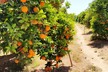
The mandarin campaign in the province of Huelva has not started off on the right foot; however, growers are convinced that their production will exceed 200,000 tonnes, due to the entry into production of farms that have been grafted from other citrus, mainly oranges.
These 200,000 tonnes will mean "a record mandarin production in the province of Huelva," which for the first time would see the acreages devoted to oranges and mandarins balanced at 50-50%, with a total of 17,000 hectares of citrus, stated the president of the Citrus Growers Association of the Province of Huelva, Lorenzo Reyes. Last year, the campaign's production stood at around 150,000 tonnes of fruit.
The high temperatures recorded last summer, which have continued during the early autumn, with a total absence of rainfall and strong easterly winds during the summer months, have caused a setback to a production that, in spring, promised to be very productive because of the load observed in the trees.
The unique weather conditions in recent months have resulted in a delay in the start of the extra-early mandarin harvest campaign, leaving Huelva's goods outside the market during the month of September, a key month for Huelva's mandarin sales, as the province usually takes advantage of the precocity of its campaign in September and October, when the rest of the country's producing areas are still not ready.
This year, despite the initial abundance of fruit in the trees, thanks to timely rainfall, it has been necessary to get rid of almost half of that fruit to try boosting its calibres, which were too small to meet the needs of the most demanding markets, where prices actually cover the production costs. As pointed out by one of the managers of the farm, El Marquesado, "the trees have given us a lot of work this year."
Thus, there has been a large amount of fruit on the tree, but very small and with a very thin skin, although the quality has been good. The Clemenrubi has arrived too late, explains Lorenzo Reyes. "The Oronules, however, has performed much better, with good sizes and very good quality, although it has also been delayed for longer than producers would have liked," he adds.
The rains recorded last week will help the calibres recover somewhat, although they have arrived too late for the extra-early mandarins. However, the will have a positive impact on other varieties and on oranges.
As regards the first prices at origin for the mandarins, and according to information obtained by the Prices and Markets Observatory of the Government of Andalusia, the initial levels are low compared with the prices obtained in the 2015/16 campaign. To be precise, the average price at origin of mandarins in week 40 has ranged between 0.45 and 0.50 Euro per kilo for Clemenrubi mandarins, and between 0.40 and 0.50 Euro per kilo for Oronules mandarins; however, at the start of the 2015/16 marketing year, the prices of the earliest mandarins oscillated between 0.60 and 0.80 Euro per kilo.
The first mandarins of the 2016/17 campaign correspond to the earliest varieties of the early clementines group, such as the Clemenrubi, and of the Satsuma group, such as the Okitsu or Iwasaki.
Source: agrodiariohuelva.es