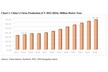
On Wednesday 12 October, the U.S. Department of Agriculture forecast that growers in Florida will collect just 70 million boxes of oranges in the coming months, down from 81.6 million in the previous harvest -- and down from the all-time peak of 244 million boxes in 1998.
The main cause of Florida’s big orange-production decline is huanglongbing, or citrus greening disease. It was detected in Florida in 2005, and has been decimating citrus groves ever since. While the disease is probably not a death sentence for the Florida citrus industry, it may leave it permanently smaller.
Then again, the Florida citrus industry was probably headed for a big decline in any case. That’s because its main product is orange juice (95 percent of Florida oranges are turned into juice), and orange juice has fallen out of favor as American consumers have come to perceive it less as a source of vitamin C than a source of sugar. The USDA’s measure of “orange juice availability per capita,” a proxy for consumption, has fallen from a peak of 6.27 gallons in 1997-98 to 2.74 gallons in 2015-2016. As a result, orange juice prices have held steady despite the production collapse in Florida and a similar huanglongbing-induced decline in Brazil, the world’s top producer of oranges and of orange juice.
That’s great for consumers, but it’s been doubly terrible for Florida growers. Normally when a disease hits a crop, higher prices make up for some of the volume decline. Not this time -- and as a result Florida orange growers’ revenues fell from $1.8 billion in 2012 to $905 million last season.
Meanwhile, demand for fresh oranges hasn’t collapsed. And, happily for orange eaters, the nation’s main producer of fresh oranges isn’t Florida but California.
That collapse in California production in 2007 was due to a freeze. Huanglongbing, while it was detected in a Los Angeles suburb in 2012 and has been spreading since in Southern California, has yet to hit the state’s commercial citrus groves, most of which are located in the San Joaquin Valley in the central part of the state. There’s a chance -- because California’s growers have had more time to prepare, and new methods of fighting the disease are being developed -- that the state’s citrus industry won’t get hammered like Florida’s has. If so, California may have a shot at reclaiming its status as the top orange-producing state, which it ceded in 1949 after the development of palatable frozen orange-juice concentrate transformed the juice from special treat to breakfast staple, and Florida growers took charge of the nascent industry.