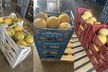
Coscia summer pears are currently being harvested - quality depends on the area, cultivation technique and weather.
We talked to producer Carmelo Catania (in the photo) from Bronte, an area famous for pistachios. He chose to also grow pears to diversify his production.
"The fruit is excellent, maybe because I have grafted on quince, or maybe because I am very careful about irrigation. Anyway grades are good and the organoleptic quality is excellent. Prices also look satisfactory, so we hope they will continue to be so."
Carmelo also planted the Carmen variety, but had to dig everything up after a few months. "Trees were affected by the fire blight. They had been infected already in the nursery garden. It caused a lot of damage and it discouraged me."
In this area, pear psyllid (Cacopsylla pyri) is one of the most feared insects. "We cannot relax and must monitor orchards all the time. If we are not careful, the insect attacks the fruit and then there is little we can do."
Carmelo also planted the Carmen variety, but had to dig everything up after a few months. "Trees were affected by the fire blight. They had been infected already in the nursery garden. It caused a lot of damage and it discouraged me."
In this area, pear psyllid (Cacopsylla pyri) is one of the most feared insects. "We cannot relax and must monitor orchards all the time. If we are not careful, the insect attacks the fruit and then there is little we can do."
Carmelo decided to diversify production and not to focus exclusively on pistachios. Summer pears are a good choice, though the commercialisation and organisation side is not very good.
"When I read FreshPlaza articles, I can see how, despite market problems, the north is more organised. They have cooperatives and technical assistance, so producers are never alone. We are completely alone, it is almost impossible to cooperate with others. In this area, only few cultivate pears. Things need to change."