The Italian pear sector has always been rather static, though there are some ideas of how to renew it. The fact that new organisations are being created (see for example Opera and Origine Group) is a positive sign for the relaunch of the industry. Innovation also plays an essential role.
The first Falstaff pear trees were planted six years ago. The variety was created from the genetic improvement carried out in Forlì by CREA-FRF. The cultivar was granted with a temporary licence to the members on New Plant.
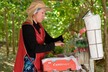
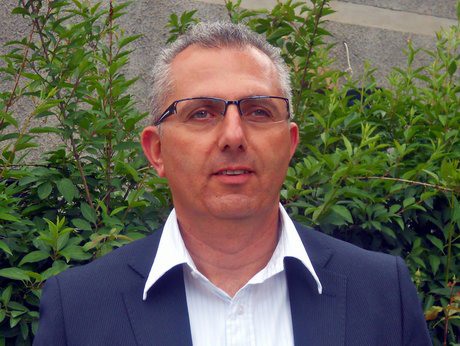
On 22nd March 2016, Apofruit Italia's technical manager Andrea Grassi (in the photo below) presented a report on the cultivation and commercialisation of Falstaff pears.
This type of red pear adapted well to the Emilia-Romagna area, the main pear-production area in Italy. "Grades are big and the colour always covers at least 60-70% of the surface. Over the years, New Plant's technical group has developed agricultural techniques that are more suitable to this variety which, even though similar, must not be managed as the Abate Fetel. It also needs specific rootstocks. The harvesting period is similar to that of the Abate variety though, and starts in early September."
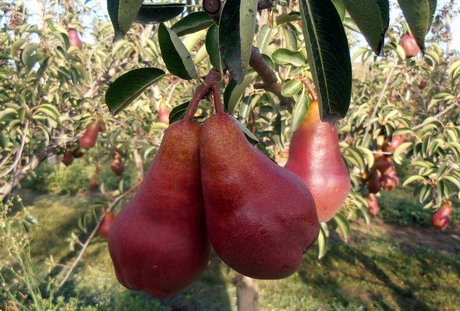
An appetizing pear
"We were particularly impressed with its flavour - it is sweet and aromatic."
In addition, Falstaff is "easier" to enjoy than other more traditional varieties. "Consumers usually find it difficult to identify the perfect moment to enjoy pears, especially since the most traditional varieties can be woody if they are not ripe. Falstaff is different because it is sweet and pleasant even when it is still rather crunchy. This means it is also ideal for the younger public."
Another interesting characteristic is its shelf-life as, when stored in refrigerated units, its properties remain unaltered for months.
First 2016 volumes
New Plant companies have planted around one hundred hectares of Falstaff, 15 of which are owned by Apofruit. We are talking about young plants, so the first volumes available will be rather limited, but they are perfect for tests in wholesale markets.
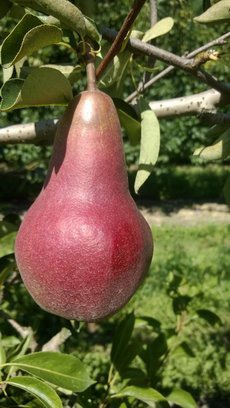 | 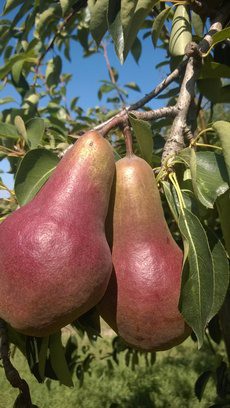 |
"Quantities will be more interesting from 2018 onwards. Our objective is to reach one hundred hectares cultivated by our partners in 4-5 years. We are moving quite slowly a the moment, but that is due to a number of factors. Considering the evolution of the sector and a reasonable campaign, I would say we will be able to make up for lost time. We have to wait, and we cannot do otherwise. There is a future in which those who were willing to face a challenge and consider results in the medium-long term will be able to maintain their companies."