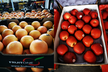
Orient Green is a pomelo growers’ representative from Pinghe, in the heart of one of the biggest pomelo producing regions in China. Liz Lu is the company's international marketing manager.
“In recent years the European market has been slow. Up to a few years ago, it was a very good market. Between 2008 to 2010, a number of problems came up concerning quality and toxic residues. Importers and consumers lost trust. Some retailers even announced that they would stop the selling of pomelo all together.”

“In 2009, we launched a new regime of quality controls. In China, most pomelo growers are small farmers. Implementing any new system, hence, comes at high costs. After two years of running our new system, we had to conclude that a part of the growers has not been fair to us about what chemicals they had used on the crops. Their accounts, spray records as we call them, did not match the test results of the tests we ran in our laboratory”.
“We then completely revised the way we operated. We selected the growers that did not cheat our tests. We launched a cooperation with quality and food and safety experts sent to us by our European clients. We started to select and purchase the pesticides that our growers would use. In addition, we would give very accurate instructions to our growers on how to use the pesticides.”
“We recently confirmed our spray method for 2016 with our main buyers. Each year before the blooming period starts we go through the entire plan with the food safety experts advised to us by our clients. The pomelo trees will start to bloom later this month, which is when most programmes start. The rest of this month me and my team will travel around to meet with growers. During organised meetings we will instruct our growers. We use pesticides that are made by international manufacturers such as Bayer, BASF etc.”
Chinese market becoming gaining momentum
The Chinese market is becoming more attractive to local producers than the European market. In recent years the government and population of Pinghe have changed and purchasing power has increased. Liz Lu explains: “best sizes and premium quality are no longer solely sold abroad, instead there is strong domestic demand. Premium pomeloes weight between 1.35 kg and 1.9 kg. Domestic customers currently tend to pay 30% more than import companies abroad for these qualities.”
“At times, too early export to Europe harms the quality of the fruit. Pomelo exported as early as wk31-34 has not fully grown on the trees. This affects the quality and the taste, and the thickness of the peel. I believe that this shortsightedness on margins is eventually harming the popularity of pomelo in Europe: the quality of the crop that the customer receives is not what is should be.”
“We instruct our grower to start the harvest only after week 34. Sometimes our customers ask whether we can start earlier, to get better margins on the market. We tell them we agreed with our growers not to harvest until the weight of the fruit is heavy enough. In addition, chemical levels in the fruit drop very fast when the harvest is postponed. One week can already make a big difference”.

Liz Lu together with Leo Yan, general manager
Focus on new varieties
“Our customers do require us to make early delivery possible. That is why we are trying to innovate our crop. We work with growers further South in China who can harvest earlier. In addition, we imported some existing new citrus varieties from Taiwan, Japan and Thailand. One of the new varieties we work with is the Golden Pomelo from Thailand. This citrus ripens earlier than the Honey Pomelo does, it’s warmly welcomed by the Asian market. Hopefully we can introduce this new variety later this autumn.”
 For more information, please contact:
Liz Lu
Orient Green International (HK)
www.orientgreenhk.com
Contact number: +86 13906069877
Email: [email protected]